
Karakorum
Mongolia47.20°N 102.82°E · 1,478 m
21 places in the index.
47.20°N 102.82°E · 1,478 m
47.92°N 106.92°E · 1,350 m
Altai Tavan Bogd National Park is a vast mountainous park on Mongolia's western border, home to the country's highest peak, Kuiten Uul (4374 m), and 34 glaciers. It is part of a UNESCO World Heritage Site with tens of thousands of petroglyphs, Turkic Stone Men, and ancient burial mounds.
Atlas entry
Arvayheer is the administrative capital of Övörhangai province, positioned along the central Mongolian steppe as a practical stopover between Ulaanbaatar and the western aimag of Bayanhongor. The town has a distinctly Soviet-era administrative feel with wide streets and modest concrete buildings, offering little in the way of conventional tourism but serving as a jumping-off point for visitors heading to the historic ruins of Karakorum to the north.
Atlas entry
Bayanhongor serves as a gateway to the southern Gobi Desert region and Great Gobi A National Park. The city offers a rare glimpse into restored Tibetan Buddhist culture at the site of the former Gegeen Monastery, once one of the largest in Mongolia with over 10,000 monks.
Atlas entry
Bulgan is a small provincial city of roughly 18,000 people positioned in Mongolia's agricultural heartland. It offers a rebuilt monastery with about 30 active monks, an extinct volcano nature reserve 60 km south, and a modest cluster of museums covering ethnic groups, the communist era, and Mongolia's first astronaut J Gurrangchaa.
Atlas entry
Choibalsan serves as the administrative and economic hub of eastern Mongolia's Dornod province. The city offers a glimpse into post-Soviet urban life with Soviet-era monuments, a rare Chinatown, and access to Onon-Balj National Park where Genghis Khan was allegedly born.
Atlas entry
Dalanzadgad is a utilitarian provincial capital of 25,000 people (2017) in southern Mongolia's Ömnögovi province. It's not an attractive destination in its own right—dusty roads and black smoke from the power station characterize the town.
Atlas entry
Darkhan is the third-largest city in Mongolia with 74,000 residents, serving as a major transit hub on the Trans-Mongolian Railroad between Ulaanbaatar and the Russian border. The city was built by the Soviets in 1961 as a manufacturing base, and today retains a distinctive Soviet-era layout with wide boulevards, industrial facilities, and a split personality between Old and New Darkhan.
Atlas entry
Erdenet is a planned Soviet-era city of nearly 89,000 people, Mongolia's second largest city and the capital of Orhon province. The city exists because of one of the world's large open pit copper mines, making it alongside Ulaanbaatar the most developed town in the country.
Atlas entry
Gobi Gurvan Saikhan is Mongolia's most accessible national park, offering a dramatic contrast to the typical grassland steppe. The park features the iconic Khongor sand dunes rising over 300 meters, the narrow ice-filled gorge of Yolyn Am, and the paleontologically significant Flaming Cliffs at Bayanzag where Roy Chapman Andrews discovered dinosaur eggs in the 1920s.
Atlas entry
Gorkhi-Terelj National Park is considered one of the most scenic areas in all of Mongolia, located just 55 km outside Ulaanbaatar. The park features a beautiful river, forests, and interestingly shaped rocks in a mostly unspoiled natural setting.
Atlas entry
Hovd (Khovd) is a small but culturally rich aimag center in western Mongolia with around 30,000 residents. Its unique appeal lies in extraordinary ethnic diversity—Kazakhs and seven different Mongolian ethnic groups—each with distinct dialects, clothing, dances, and musical instruments.
Atlas entry
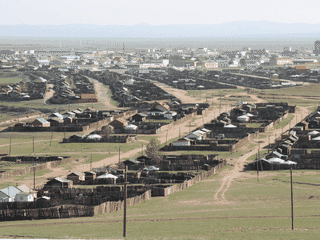
Karakorum brings Mongol Empire history, Tibetan Buddhist monasteries, and immersive ger camps together on the steppe. The UNESCO-listed ruins and Erdene Zuu Monastery make it a focused base for historic sites and countryside excursions.
Mörön is the administrative capital of Mongolia's northernmost province Hövsgöl, established in 1933 on the site of a former monastery. The town serves as the essential transit hub for travelers heading to Lake Khövsgöl 100 km north, or continuing to Terkhiin Tsagaan Nuur.
Atlas entry
Ölgii is the capital of Bayan-Ölgii province in western Mongolia and the cultural heartland of Kazakhstan's diaspora in the country. The city serves as the primary access point for Altai Tavan Bogd and Tsambagarav National Parks, with their snow-capped mountains, glaciers, and abundant wildlife.
Atlas entry
Ondorkhaan (also called Chinggis City) is a quiet provincial capital of about 15,000 people in Eastern Mongolia's Hentii province. The city is notable for its unusually high concentration of Genghis Khan statues, even by Mongolian standards, making it a pilgrimage site for those tracing the Great Khan's legacy.
Atlas entry
Sainshand is a small provincial capital carved into the southern Gobi steppe, serving as a quiet railway junction on the Trans-Mongolian line between Ulaanbaatar and the Chinese border. Travelers pass through for the desert monastery Hamriin Hiid, the cultural collections of the Provincial Central Museum, or as a stopover on the classic Beijing–Ulaanbaatar overland route.
Atlas entry
Tsetserleg is the capital of Arkhangai province and is widely regarded as the most pleasant of Mongolia's provincial capitals. Set in a beautiful forested valley in the Khangay mountains, this town of around 20,000 people offers a relaxed atmosphere compared to larger cities.
Atlas entry
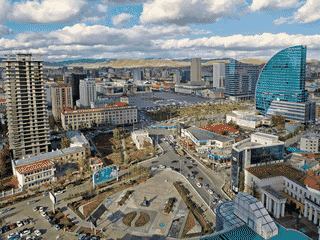
Ulaanbaatar is Mongolia’s cultural, economic, and transportation hub, home to roughly half of the country’s 1.6 million residents. Central guesthouses and landmark-based navigation make it a practical starting point for a wider Mongolia itinerary.
Ulaangom is the capital of Uvs province and serves as the practical gateway to northwestern Mongolia's most dramatic landscapes. The city sits near Uvs Lake (Uvs Nuur), a gigantic inland sea five times saltier than the ocean, whose basin is a UNESCO World Heritage Site.
Atlas entry
Uliastai is the capital of Zavkhan province and a former provincial capital of the Manchu Empire, offering a rare window into provincial Mongolian life. The town sits at the border of the desert and forest in a valley where the Bogdiin and Chigestai rivers converge, surrounded by the Khangai mountains.
Atlas entry
Zuunmod serves as a peaceful counterweight to Ulaanbaatar's bustle, sitting just 40 km from the capital on a well-paved road. The town of 15,000 functions as a provincial capital with a small museum, one rebuilt temple-museum, and easy access to the ruins of Manzushir Monastery.
Atlas entry
In development: the whole atlas offline, a trip planner and a private journal. We'll post here when it ships. No newsletter to join.
