
Luang Prabang
Laos19.88°N 102.13°E · 305 m
24 places in the index.
19.88°N 102.13°E · 305 m
Boten is a rough-and-ready border town at the northern edge of Luang Nam Tha Province, serving as the Laos-China crossing point. The completed railway connecting Vientiane to Kunming in China makes Boten a key transit hub, though the town itself has little to offer tourists beyond crossing logistics.
Atlas entry
Champasak is a quiet riverside town that serves as the gateway to Wat Phou, one of Southeast Asia's oldest temple complexes with Khmer-Hindu origins dating to the 2nd century BCE. The town itself has a handful of French colonial houses and a relaxed atmosphere, making it a pleasant overnight stop between Pakse and the Thai border.
Atlas entry
Don Det is a small Mekong island known for riverside guesthouses and slow-paced days. Cross the old French bridge to explore neighbouring Don Khon's temple and waterfall.
Don Khon is a small island in the Si Phan Don archipelago offering a quieter, more relaxed alternative to neighboring Don Det. The island is known for its French colonial heritage, including a former railway bridge and old French port that showcase its unique history.
Atlas entry
Don Khong is the largest island in the Si Phan Don archipelago, offering a quieter alternative to the more touristy Don Khon to the south. The island has about 20 villages where locals make their living primarily by fishing and depending on the Mekong River.
Atlas entry
Huay Xai is a Mekong-side town across the river from Chiang Khong in Thailand. It is a starting point for the slow boat to Luang Prabang and forest stays with the Gibbon Experience.
Luang Namtha is a northern Lao base for trekking, kayaking and village visits. Guesthouses and tour companies cluster in the new town, with Lao food available at the night market.
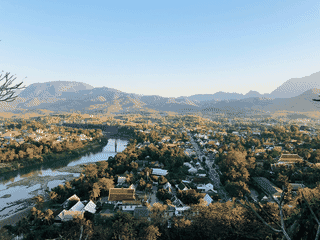
Luang Prabang sits where the Mekong and Nam Khan rivers meet, with wooden houses and Buddhist temples. Explore the town before taking a trip to Kuang Si Falls or trying Lao dishes at the night market.
Muang Khua is a small Nam Ou transit town with river views and local markets. An old suspension bridge and nearby trekking routes add reasons to pause.
Muang Ngoi Neua is a small base for caves, village walks and steep valley viewpoints. The surrounding settlements offer day hikes and overnight stays reached along rural paths.
Muang Sing is a frontier town surrounded by culturally diverse highland villages. Markets, temples and nearby waterfalls offer a base for exploring the northwest.
Muang Xay is a transport town in a mountain basin in northern Laos. Use it as a base for Phu That Stupa, the Oudomxay Museum and trips toward Nam Kad Waterfall.
Nong Khiaw sits between limestone mountains beside the Nam Ou. Viewpoint hikes and wartime caves give it a varied outdoor and historical circuit.
Pakbeng overlooks the Mekong along the slow-boat route between Huay Xai and Luang Prabang. Its overnight-stop rhythm shapes the waterfront stalls and guesthouses.
Pakse sits where the Xe Don meets the Mekong and serves as a transport base in southern Laos. Use it for trips toward the Bolaven Plateau, waterfalls and the temple complex at Wat Phou.
Paksong is a cool Bolaven Plateau town surrounded by coffee country. Waterfall trips and plantation walks make it a useful highland stop.
Phonsavan is a highland town and gateway to the Plain of Jars. Combine archaeological visits with war-history exhibits and local markets, allowing extra time for travel into the countryside.
Sam Neua is a quiet provincial base for the former Pathet Lao caves at Vieng Xai. Markets and the surrounding countryside add interest to a stop in the northeast.
Savannakhet is a Mekong-side city with French colonial buildings and a regional dinosaur museum. Explore the old centre, then consider a bicycle trip toward That Ing Hang Stupa and nearby countryside.
Sayabouly is a small provincial capital in Northern Laos, serving primarily as a transit stop and gateway to the Elephant Conservation Center at Nam Tien Lake. The city itself is quiet with minimal conventional attractions, but draws travelers interested in elephant conservation and those traveling between Luang Prabang and the Thai border regions via Hongsa or Pak Lay.
Atlas entry
Thakhek is a working riverside town and a base for a limestone-country motorbike circuit. Riverfront food stalls and nearby climbing give reasons to pause between excursions.
Vang Vieng sits on the Nam Song River among limestone formations. The town is a base for kayaking, cave visits and walks to viewpoints and lagoons.
Vieng Xai is a small town in Hua Phan province that few travelers would have reason to visit were it not for its extraordinary cave system. The limestone karst network sheltered the entire Pathet Lao revolutionary headquarters during the Secret War (1964-1973), supporting a hidden underground city of up to 23,000 people including schools, hospitals, a radio station, and a theatre.
Atlas entry
Vientiane offers Buddhist temples, French colonial architecture and a riverside promenade. Explore Pha That Luang and Wat Si Saket, then spend the evening at the night markets or riverfront.
In development: the whole atlas offline, a trip planner and a private journal. We'll post here when it ships. No newsletter to join.