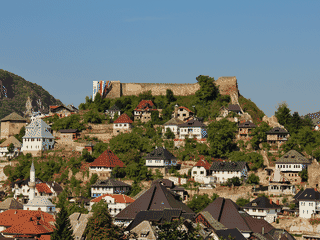

Jajce
Bosnia and Herzegovina44.34°N 17.26°E · 450 m
16 places in the index.
44.34°N 17.26°E · 450 m
43.33°N 17.80°E · 60 m
43.85°N 18.39°E · 527 m
Doboj is a pivotal city in northeastern Bosnia at the confluence of the Usora, Spreca, and Bosna rivers. The city stands out for its remarkable religious coexistence, with Orthodox, Catholic churches, and mosques located in close proximity.
Atlas entry
Jablanica is a small town in Herzegovina sitting on a lake of the same name along the Neretva River. While not a destination with overwhelming sights, it serves as a base for hikers exploring the surrounding mountains and attracts history enthusiasts drawn to the famous railway bridge sabotaged by Yugoslav partisans during WWII.
Atlas entry
Jajce's Pliva Waterfall sits where the Pliva meets the Vrbas River. A hilltop fortress overlooks an old town dotted with historic monuments.
Konjic is a small town between Sarajevo and Mostar on the Neretva river in Herzegovina, offering a quieter alternative to Bosnia's major tourist destinations. The town combines Ottoman-era architecture with Cold War history and some of Europe's best white water rafting.
Atlas entry
Krupa na Vrbasu is a picturesque small town nestled in a valley between canyons of the Vrbas River in northern Bosnia and Herzegovina. The star attraction is the Krupa waterfall, where crystal-clear waters rush down past traditional watermills, creating a charming scene.
Atlas entry
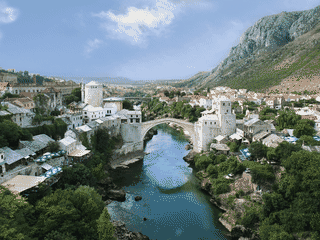
Mostar centers on the rebuilt Old Bridge above the Neretva River. This UNESCO-listed landmark gives the city a memorable focal point.
Neum is Bosnia and Herzegovina's only coastal settlement, a 9-kilometer stretch of Adriatic shoreline that divides Croatia. The town serves as a convenient beach resort cheaper than surrounding Croatia, offering budget travelers access to the Mediterranean without Dalmatian prices.
Atlas entry
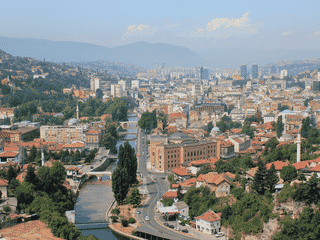
Sarajevo blends Ottoman and Austro-Hungarian heritage. Yugoslav history adds another layer to the city visitors explore today.
Široki Brijeg is a small Bosnian town on the Lištica River in northern Herzegovina, known locally as 'Široki'. The town serves primarily as a transit stop between the Adriatic coast and the Bosnian interior, with Mostar located just 20-25 km away.
Atlas entry
Srebrenica is a small city of about 3,000 people in northeastern Bosnia and Herzegovina, primarily significant as the site of the 1995 genocide during the Bosnian War. Under UN (Dutch peacekeepers) protection, the safe haven was attacked and over 8,000 Bosnian Muslim men and boys were systematically killed.
Atlas entry
Teslic is a well-known spa destination in Republika Srpska, primarily famous for Banja Vrućica health spa with thermo-mineral waters used to treat cardiovascular diseases. The town offers a complex of five hotels with over 1000 beds capacity, making it the largest tourist destination in Bosnia and Herzegovina.
Atlas entry
Travnik served as the Ottoman capital of Bosnia from 1699 to 1851, hosting 77 grand viziers and leaving behind well-preserved Ottoman architecture. Nobel laureate Ivo Andric set his novel "The Travnik Chronicles" here, and you can visit his birth house turned museum.
Atlas entry
Trebinje is a small city in the Trebišnjica river valley in southeastern Herzegovina, about 30 km by road from Dubrovnik, Croatia. Called "the city of sun and plane trees," it is one of the most beautiful cities in Bosnia and Herzegovina and remains an authentic counterpoint to tourist-trapped Dubrovnik.
Atlas entry
Tuzla is Bosnia's third-largest city, primarily known for its industrial heritage and salt production. Tourism has developed in the 21st century, centered around the Pannonica salt lakes and memorial sites.
Atlas entry
Višegrad is a small riverside town famous for the 1577 Mehmed Paša Sokolović Bridge spanning the Drina, a UNESCO World Heritage Site. The town gained literary immortality through Ivo Andrić, who won the 1961 Nobel Prize for "The Bridge on the Drina," a novel set in the town.
Atlas entry
Zenica is Bosnia and Herzegovina's fourth-largest city, roughly 70 km north of Sarajevo along the Bosna river, surrounded by mountains and hills. The city blends an industrial present — dominated by the Zenica Steelworks — with a historic Stara čaršija (old quarter) containing Ottoman-era mosques, a former synagogue turned gallery, and Austrian-era fountains.
Atlas entry
In development: the whole atlas offline, a trip planner and a private journal. We'll post here when it ships. No newsletter to join.

