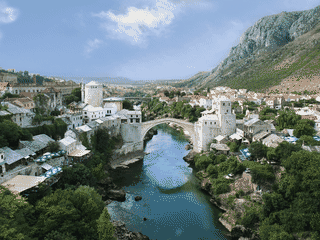

Mostar
Eastern Europe and the Balkans · Bosnia and Herzegovina
Did you know?
- Koski Mehmed Pasha Mosque has a minaret viewpoint.
- Ćevapčići are grilled minced meat, a staple of local menus.
- Bridge divers plunge into the emerald Neretva.
See also

Makarska
Croatia43.30°N 17.03°E · 0 m
Overview
Mostar centers on the rebuilt Old Bridge above the Neretva River. This UNESCO-listed landmark gives the city a memorable focal point.
Languages: Bosnian, Croatian, Serbian
Why go?
Mostar is a city in Bosnia and Herzegovina that has risen from devastating 1990s war damage to become a lively and beautiful destination. The crown jewel is the UNESCO-listed Old Bridge (Stari Most), rebuilt in 2004 using original stones recovered from the Neretva River. Beyond the stunning Ottoman architecture of the old town, Mostar offers budget-friendly hostels, hearty grilled meats, and proximity to charming villages like Počitelj and Blagaj—all without the crowds of coastal Croatia.
Adapted from Wikivoyage contributors · CC BY-SA 4.0
Getting in
Mostar is accessible by bus from Dubrovnik (2 per day, 3-4 hours, 30 KM), Split (4 hours, 16 EUR), Zagreb, Banja Luka, Belgrade (2 per day), Jajce (3½-4 hours, 19 KM), and Podgorica. The main bus station is on Maršala Tita in the eastern part of the city, near the Carinski bridge. Buses from Podgorica stop several kilometres from the centre on an expressway—a taxi costs 10 KM. Timetables are available online at autobusni-kolodvor.com. The city also has an airport (OMO) and a train station on Maršala Tita.
Adapted from Wikivoyage contributors · CC BY-SA 4.0
Getting around
Mostar is a compact city best explored on foot. The Old Town and most attractions are within walking distance of each other. The main east bus station is on Maršala Tita in the eastern part of the city; the western bus station is on Vukovarska in the northwest. The train station is also on Maršala Tita with platforms opening 30 minutes before departure. Taxis are available but the city centre is walkable.
Adapted from Wikivoyage contributors · CC BY-SA 4.0
When to go
The best time to visit Mostar is late spring (May-June) or early autumn (September-October) when the weather is warm but not scorching. Summer can be crowded and hot, while winter sees fewer tourists but some establishments may have reduced hours. The city has a Mediterranean climate with hot summers and mild winters. Visiting in 2024 marks the 20th anniversary of the Old Bridge reconstruction.
Adapted from Wikivoyage contributors · CC BY-SA 4.0
Where to stay
Mostar has excellent budget accommodation centered around the Old Town. Hostel Nina (20-30 KM, free pick-up from stations) and Hostel Majda's Rooms (20 KM dorm) are highly recommended, with free breakfast and friendly English-speaking staff. Hostel Golden Bridge offers dorms for 14-18 KM with a family atmosphere. For slightly more comfort, Hotel Bevanda provides four-star luxury near the river for those willing to spend more. The Old Town area offers the most convenient base for exploring on foot.
Adapted from Wikivoyage contributors · CC BY-SA 4.0
Food and drink
Mostar's culinary scene centers on hearty Bosnian meat dishes. Ćevapčići (grilled minced meat) is the staple—try it at Ćevabdžinica Tima - Irma for 6 KM in the Old Town. Aščinica Saray on Karađozbegova offers meals from 5-12 KM, excellent value. For a splurge with a view, Kulluk and Labirint both overlook the Stari Most. Bosnian coffee is a ritual—not to be confused with Turkish coffee. Visit Cafe de Alma on Rade Bitange for an authentic 2 KM coffee served in traditional style with Turkish delight. The Old Bazaar Kujundžiluk has countless cafes for people-watching.
Adapted from Wikivoyage contributors · CC BY-SA 4.0
Things to do
The Old Bridge is the absolute highlight—watch local divers plunge 21 meters into the emerald Neretva below (expect to tip them a few marks). Climb the minaret of Koski Mehmed Pasha Mosque for panoramic views (14 KM with minaret access). The Old Bridge Museum (10 KM) documents the bridge's history and reconstruction. Muslibegovića House (6 KM) is the most beautiful Ottoman house in the Balkans, with 300 years of history and optional traditional refreshments. Walk along Bulevar Revolucije to see the sobering former front line—bombed buildings still standing just 5 meters from the division. For adventure, Park Fortica offers ziplines and via ferrata.
Adapted from Wikivoyage contributors · CC BY-SA 4.0
Buy
The Bosnia and Herzegovina convertible mark (KM or BAM) is pegged to the euro at €1 = 1.95583 KM. Many shops and restaurants in the Old Town accept euros at a 1:2 rate with the convertible mark. Multiple banks and ATMs are scattered across the city. The Old Town has many ATMs, including one next to tourist company across Restaurant Kulluk and Europa. For souvenirs, head to the Old Bazaar Kujundžiluk for handicrafts, carpets, and jewelry.
Adapted from Wikivoyage contributors · CC BY-SA 4.0
Safety
Mostar is generally safe for tourists. As of 2022, pickpocketing occasionally occurs near the Old Bridge and other crowded tourist spots, but serious crime is rare. The former front-line areas have some bombed-out buildings—curious to see but exercise normal caution. Tap water is potable. The river water is cold (constant 12°C) and diving from the bridge is extremely dangerous—local divers are professionals who acclimatize carefully; do not attempt this yourself.
Adapted from Wikivoyage contributors · CC BY-SA 4.0
Connectivity
Since 2016, fast and free Wi-Fi provided by TGM is available in the vicinity of the Stari Most (Old Bridge). Most hostels offer free Wi-Fi for guests. SIM cards from local providers are available for data needs. The city uses Type F electrical plugs (European round pins with grounding).
Adapted from Wikivoyage contributors · CC BY-SA 4.0
Day trips
Several compelling destinations are within easy reach of Mostar. Počitelj features an ancient Stjepan-grad fort and Ottoman architecture, just a short journey south. Blagaj is famous for its stunning tekke (Dervish monastery) perched at the base of cliffs by the Buna River. Međugorje attracts pilgrims with its claimed Marian apparitions. Stolac offers prehistoric archaeological sites and Ottoman-era architecture. Kravica has a beautiful waterfall, perfect for summer visits. Buses connect Mostar to these destinations regularly.
Adapted from Wikivoyage contributors · CC BY-SA 4.0
Go next
From Mostar's bus stations, you can reach coastal Croatia easily—Dubrovnik is 3-4 hours away (30 KM) and Split is about 4 hours (16 EUR). Zagreb is a longer journey but well-connected. Within Bosnia, Jajce (3½-4 hours, 19 KM) is a historic gem with its famous waterfall and medieval fortress. Banja Luka and Belgrade offer connections east. For Italy, consider routing through Split for ferries to Ancona or Pescara.
Adapted from Wikivoyage contributors · CC BY-SA 4.0
Field guide adapted from Wikivoyage contributors · CC BY-SA 4.0. Text has been adapted and organized for this guide. About our sources.
Places to know
A few starting points from the guide. Check current hours and prices before you go.
- sleep
Biba
Three furnished two bedroom apartments with terraces on Neretva River directly over looking the Mostar Old Bridge.
Adapted from Wikivoyage contributors
- sleep
GuestHouse Taso
Free Wi-Fi, tours around Mostar. Free pick up service 24 hr.
Recorded price: 22 KM dorm; 44 KM private double
Adapted from Wikivoyage contributors
- sleep
Hostel Bojo, bed & breakfast
In the pedestrian zone of Mostar centre, about 500 m from the Old Town, Hostel Bojo offers air-conditioned rooms with lockers for each bed, free Wi-Fi and free breakfast. Guests can use the shared garden's seating area with free barbecue facilities. Has a common room with cable TV, and guests are welcome to use a shared fully equipped kitchen with dining area. A shared bathroom with shower and hairdryers are available.
Recorded price: 22 KM
Adapted from Wikivoyage contributors
- sleep
Hostel Golden Bridge
Small hostel with a family atmosphere, staffed by the outrageous Stephan, kitchen, parking, Wifi. Thoroughly recommended.
Recorded price: Dorms 14-18 KM
Adapted from Wikivoyage contributors
- sleep
Hostel Majda's Rooms
This is the first hostel in Mostar. The owner, Majda, is very friendly and will bend over backwards to accommodate you, suggest restaurants, bars, sights and day trips. Free internet, TV, kitchen, linen. Homecooked breakfast and coffee for free every morning. A city tour is offered.
Recorded price: Dorm bed: 20 KM
Adapted from Wikivoyage contributors
- sleep
Hostel Miturno
Cool clean hostel in the Old town. Free Wi-Fi, staff speaks very good English.
Recorded price: 22 KM dorm; 40 KM private
Adapted from Wikivoyage contributors
- sleep
Hostel Nina
Clean hostel in the Old town. Free internet, staff speak very good English. Free pick up from the bus/train station can be arranged. In their own bar on the Old bridge you can taste local drinks for local prices; first round is always on the house if you are a guest of the hostel.
Recorded price: 20-30 KM
Adapted from Wikivoyage contributors
- eat
Aščinica "Saray"
A great place to have cheap and good dishes. Prices range from 5 KM to 12 KM for a big meal.
Recorded price: From 1 KM
Adapted from Wikivoyage contributors
Before you go
Connectivity
Free TGM WiFi near the Old Bridge. Most hostels provide free WiFi. Local SIM cards available for data. Power outlets are European Type F.
Culture
Mostar has Ottoman and Mediterranean influences. Dress modestly when visiting mosques. Bosnian coffee culture is an important ritual—take time to enjoy it. The city is still healing from its 1990s war; be respectful when discussing history.
Money
The Bosnia and Herzegovina convertible mark (KM/BAM) is pegged to the euro. Euros are widely accepted in tourist areas at a 1:2 rate. ATMs are plentiful in the Old Town. Budget travelers can get by on 30-50 KM per day including dorm accommodation and meals.
Safety
Mostar is generally safe with petty theft occasionally occurring near the Old Bridge. The former front line on Bulevar Revolucije has exposed bombed buildings—fascinating but avoid wandering off main paths at night.
Transport
Mostar's main bus station is east of centre on Maršala Tita. Buses to Dubrovnik (30 KM, 3-4 hrs), Split (16 EUR, 4 hrs), and Jajce (19 KM, 3½-4 hrs) are frequent. Taxis from outlying bus stops cost around 10 KM.