Overview
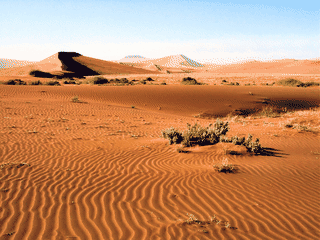
This enormous desert reserve combines red dunes, hiking, and wildlife adapted to harsh conditions. Its western Namib Sand Sea is a UNESCO-listed landscape.
Desert · Nature · Trekking · Off The Trail · Wildlife
Did you know?
- Sossusvlei is a clay pan produced by Tsauchab River deposits.
- The reserve was established in 1907 and now covers nearly 50,000 km².
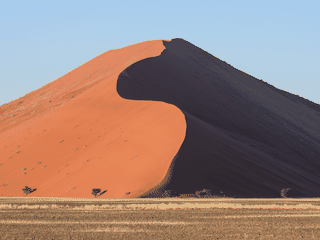
- Dune 45 rises 170 meters and sits about 45 km from Sesriem.
Where it is
Namib-Naukluft National Park is 197 km southeast of Walvis Bay.
Why go?
Namib-Naukluft National Park is one of Africa's most spectacular wilderness areas, covering nearly 50,000 km² as the continent's largest and the world's 4th largest nature reserve. Its western section, the Namib Sand Sea, is a UNESCO World Heritage Site featuring iconic red dunes that are among the tallest in the world. The park offers extraordinary desert landscapes, excellent hiking trails, and unique wildlife adapted to harsh conditions.
Understand
The Namib-Naukluft is one of the oldest protected areas in Namibia, established in 1907. Today it covers nearly 50,000 km², making it Africa's largest and the world's 4th largest nature reserve. Much of the park is inaccessible to humans—either without roads or with restricted access. The impassable areas can only be explored by air, with several airstrips available for panoramic flights.
Get in
Access the park by driving on the C26 from Windhoek, which crosses through the park. Alternatively, drive the B4 inland and turn northwards at Aus. Most visitors arrive by rental car, typically starting from Windhoek or the coastal towns of Swakopmund and Walvis Bay. The main park entrance near Sesriem is the gateway to Sossusvlei and Dune 45.
Fees and permits
Public roads crossing the Namib-Naukluft Park can be used free of charge, except D roads towards Gobabeb and the road to Sossusvlei. Permits are required when branching onto unproclaimed roads or accessing state-managed accommodation; purchase them at Sesriem or Naukluft Camp offices, or at Ministry of Environment and Tourism offices in Windhoek (corner of Bismarck Street and Sam Nujoma Avenue) and Swakopmund (Uhland Street). Entrance costs N$80 per person (children under 16 free, N$10 per car). Camping permits are available at higher prices than private camp sites.
Get around
Major attractions are accessible via gravel roads in various states of maintenance. A 4x4 is not necessary for crossing the park on C-roads but provides much more comfort and safety. D-roads require strong nerves in a sedan—expect sandy patches, river crossings without bridges, steep ascents/descents, and closed farm gates. Undesignated roads require an all-terrain vehicle. Inaccessible park areas can be explored by air; panoramic flights can be booked in Swakopmund, Walvis Bay, and Lüderitz, but not in the park itself.
See and do
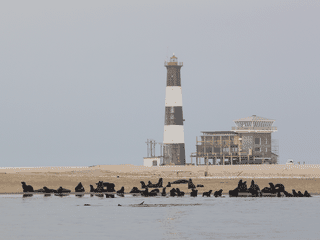
Dune 45 rises 170 meters high and sits approximately 45 km from Sesriem on the way to Sossusvlei—all large dunes in Namibia are numbered starting with Dune 1 at the coast. Sossusvlei is a clay pan produced by Tsauchab River deposits; after good rainy seasons it fills with water. The adjacent Dead Vlei features centuries-old dead tree trunks in spectacular contrast to the surrounding dunes. Sesriem Canyon, formed during the Dorsland Trek era, is walkable and impressive. Sandwich Harbour, 45 km south of Walvis Bay, hosts large bird colonies including famous flamingoes. Gobabeb is an environmental research center that holds an annual open day. The park offers hundreds of scenic hikes; three well-known trails start from Naukluft Camp (3-hour and 1-day hikes need no special preparation; the 8-day hike requires a special permit, doctor's letter, and booking confirmation). Hot air balloon rides are available at Solitaire for around N$ 4,500 per person.
Stay safe
The park is notorious for car accidents involving tourists, almost always due to speed and often burst tyres. The 100 km/h speed limit on gravel roads is rarely safe. Key safety tips: don't overload vehicles (check rear spring blades—they need to be U-shaped, not flat); reduce tyre pressure so tyres form barely noticeable pockets for better traction; avoid sharp stones by driving in existing tracks where edges have been smoothed; avoid animal collisions by driving slowly, not by steering abruptly or braking hard; exercise extra caution on freshly graded stretches where the street grader has turned sharp stone tips upward.
Go next
The park is part of the Hardap region. Nearby destinations include Walvis Bay and Lüderitz on the coast, Swakopmund for adventure activities, and the coastal towns serve as gateways for park access. Windhoek is the main hub for international arrivals.
Budget planning
Key costs: Park entrance N$80 per person plus N$10 per car. Camping at Naukluft Camp costs N$190 per person per night. Budget an additional N$150-300 per day for fuel, food, and activities. Hot air balloon rides at Solitaire are approximately N$ 4,500 per person.
Guide text adapted from Wikivoyage contributors under CC BY-SA 4.0.
Where to start
Sleep
Koiimasis
Installations and buildings blend into the surrounding rocks. During dusk and dawn small antelope and rock dassies are all over the place. There are chalets, rooms, and a campsite. There is also a pool, unfortunately only for the guests of the lodge.
Price when recorded: Camping N$200 per person, children half price
Sleep
Mount D'Urban
Camp site with pool, 8 camping spots. Camping on gravel, artificial shade, private ablution facilities. Solar power, max 2 Amp (450 W). The farmer bakes bread in the afternoon. Try it for N$ 70, the crunchiest, juiciest farmbread you will get anywhere in Namibia.
Price when recorded: Camp site N$ 270 pppn
Sleep
Naukluft Camp
Beautiful campsite under old trees in a natural setting on a creek that often carries a little water. Water and light available but no power sockets. There are rock pools uphill (30 min walk) that have water throughout the dry season. The site is frequently raided by baboons; lock all food in the car. There is also an office of Namibia Wildlife Resorts where you can buy a park permit.
Price when recorded: N$190 pppn, children N$90
Sleep
Oerwald 4x4 camp
Reception with swimming pool and bar and an astonishing collection of metal sculptures which is worth a visit even if you don't stay over. One camp site is near the farm house. Another, marker
Price when recorded: N$250 for the campsite plus 230 N$ per person, some reduction for children. Slight reduction for residents of Southern Africa. Light meals in the restaurant N$ 160-270
Sleep
Old Police Station
Two camp sites, one for exclusive use around the ruins of the marker
Price when recorded: N$285 pppn, children half price, or N$1,550 per group, max. 10 people
Sleep
Solitaire Guest Farm
Chalets and camp site, restaurant, bar, pool and wifi. There are 4 short hiking trails. The camping spots are large and on sand. There is little natural shade but each spot has a shaded rondavel with a table and chairs. Water and electricity on site.
Price when recorded: Chalets between N$ 1,200 and 1,500, camp site N$ 225, children half price. Solitaire also offers hot air ballooning at N$ 4,500 pp and a drive to a group of cheetahs in captivity at N$ 350 pp
Eat
Solitaire Bakery
Famous bakery in the small settlement of Solitaire, a welcome stop for travelers crossing the desert.
See
Dead Vlei
Pan no longer reached by the river, featuring centuries-old dead tree trunks in spectacular contrast to white clay and orange dunes.
Price when recorded: Included in park entrance fee
Before you go
Accommodation
Inside-park camping at Naukluft Camp (N$190 pppn). Private camps and lodges in surrounding areas offer similar or higher prices with more amenities.
Money
Local currency is Namibian Dollar (N$). South African Rand is also accepted at par. Credit cards may not be accepted at remote locations—carry sufficient cash for fuel, park fees, and purchases.
Packing
Bring ample water (at least 3 liters per person per day), sun protection, and food supplies. Petrol stations are sparse—fill up at Sesriem or Solitaire before heading into remote areas.
Safety
Most accidents involve tourists driving too fast on gravel roads. Reduce tyre pressure, avoid overloading vehicles, and never stop on sandy patches where your car could sink.
Transport
A 4x4 vehicle is highly recommended for comfort and safety on gravel roads. Road conditions vary significantly—expect sandy patches, river crossings without bridges, and rough surfaces.
Weather
Summer temperatures (October-March) can exceed 40°C. Winter nights drop below freezing. Sunrise and sunset offer the best photography conditions at Sossusvlei.