.png)
Nagahama
East Asia · Japan
Did you know?
- A 1890 bank building now houses a glassware and jewelry shop.
- The railway square preserves Japan's oldest existing station house.
- April 15's festival sends carved floats through the streets while boys perform kabuki.
See also

Sekigahara
Japan35.37°N 136.47°E

Gifu
Japan35.42°N 136.77°E
Hikone
Japan35.27°N 136.27°E
Overview
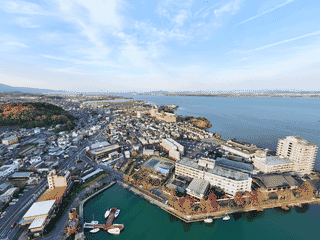
Nagahama is a compact Lake Biwa stop where a reconstructed castle, festival floats, glass studios, and walkable historic streets fit into an easy overnight. Its rail position between Kyoto and the Hokuriku coast makes it useful for travelers who want culture without a large-city pace.
Languages: Japanese
Why go?
Nagahama is a small historic city on the northeastern shore of Lake Biwa that punches above its weight for cultural depth. The reconstructed Nagahama Castle was built by Toyotomi Hideyoshi in 1575-76, and the city preserves one of Japan's three great float festivals—the Hikiyama Matsuri—along with a thriving glass-art tradition centered in Kurokabe Square. Most sights cluster within a 10-minute walk of Nagahama Station, making it an easy half-day or overnight stop for travelers routing between Kyoto and the Hokuriku coast.
Adapted from Wikivoyage contributors · CC BY-SA 4.0
Getting there
Nagahama Station sits on the JR Hokuriku Line, with direct service to Kyoto (about 1 hour), Maibara (15 minutes), and north toward Fukui and the Sea of Japan coast. From Tokyo, take the Shinkansen to Kyoto then transfer to the Hokuriku Line. Buses connect to surrounding towns and attractions including the lakeside Kohoku area and Torahime Station for visits to Omi Kōhō-an Temple.
Adapted from Wikivoyage contributors · CC BY-SA 4.0
Get around
Most tourist destinations, hotels, and Kurokabe Square are within easy walking distance of Nagahama Station. Buses depart from Stop 1 at the station for Jinshoji Temple (¥280) and other outlying sites. The flat terrain makes cycling a viable option for exploring the lake shore area.
Adapted from Wikivoyage contributors · CC BY-SA 4.0
When to go
April 15 is the date of the Hikiyama Matsuri, when elaborately carved festival floats parade through the streets and young boys perform kabuki. The Nagahama and Kita-Biwako Fireworks Festival takes place every August 5th on the lake harbor. The Bonbai Exhibition (January 20 – March 10) showcases Japanese apricot trees in bonsai form, including trees over 400 years old. Cherry blossoms around Nagahama Castle in Hokoen Park make spring visits particularly scenic.
Adapted from Wikivoyage contributors · CC BY-SA 4.0
Where to stay
Hotels cluster around Nagahama Station. Green Hotel Yes Nagahama Ekimae-kan (2 min from station) serves budget travelers, while Art Hotel Nagahama (10-min drive east) offers business-hotel amenities at Toyoko Inn price points. The ritziest option is Grand Mercure Lake Biwa Resort & Spa near the castle, which includes onsen (hot springs). For a traditional Japanese inn experience, Hamakogetsu sits north of the castle with shuttle buses from the station. Onsen-focused travelers can consider Sugatani Onsen Hotel or the more elaborate Onoe Onsen Beniayu (about ¥25,000 per night including meals).
Adapted from Wikivoyage contributors · CC BY-SA 4.0
Food and drink
Nagahama's dining scene is modest but includes a few standout options. Yum Thai (7 min drive east from station) serves Thai food with most dishes around ¥1000 in a casual setting where some staff speak English. Yakiniku Den offers Japanese BBQ with notably lower prices for women. Nagahama Roman Beer is the city's only brewery, located across the Yone River from the station, with beers ranging ¥380–2600 and food averaging ¥1000 per dish. One Coin bar charges ¥600 for all drinks and is run by an English-speaking owner named Sumi.
Adapted from Wikivoyage contributors · CC BY-SA 4.0
Things to do
Nagahama Castle (¥400 adults) sits in Hokoen Park with views of Lake Biwa and cherry blossoms in spring. The Hikiyama Museum (¥600 adults) displays the elaborate festival floats from the Hikiyama Matsuri, with a film showing boys performing kabuki as they have for over 400 years. The Kaiyoudou Figurine Museum in Kurokabe Square (¥800 adults) houses anime figures and dinosaur dioramas. Daitsuji Temple (¥500 adults) features sliding door paintings by the Kano school and is designated as a national scenic garden. The Nagahama Railway Square preserves Japan's oldest existing station house and exhibits steam locomotives.
Adapted from Wikivoyage contributors · CC BY-SA 4.0
Buying
Nagahama is known for glass art, centered in Kurokabe Square. The Kurokabe Glass Shop occupies a 1890 bank building with two floors of glassware and jewelry. Studio Kurokabe next door sells handmade pieces, with a viewing window where visitors can watch artists at work.
Adapted from Wikivoyage contributors · CC BY-SA 4.0
Go next
From Nagahama, the JR Hokuriku Line runs north to Fukui and the Sea of Japan coast (Tsuruga). Southbound trains connect through Maibara to Hikone (home to Hikone Castle), Omihachiman, and Otsu before reaching Kyoto. Sekigahara, site of the famous 1600 battle, is reachable by bus. The Meishin Expressway provides driving access westward toward Ogaki and the Kisei region.
Adapted from Wikivoyage contributors · CC BY-SA 4.0
Field guide adapted from Wikivoyage contributors · CC BY-SA 4.0. Text has been adapted and organized for this guide. About our sources.
Places to know
A few starting points from the guide. Check current hours and prices before you go.
- sleep
Art Hotel Nagahama
A national chain; calls itself a "business hotel", but it definitely appeals to travelers seeking a hotel minus frills but with amenities you wouldn't find in a hostel. It's comparable to another national chain called Toyoko Inn, and priced similarly.
Adapted from Wikivoyage contributors
- sleep
Grand Mercure Lake Biwa Resort & Spa
Has several in-house restaurants. Also has onsen (hot springs). It's probably the ritziest hotel Nagahama has. Also in Hokoen, between Kitabiwako Hotel Grazie and the castle.
Adapted from Wikivoyage contributors
- sleep
Green Hotel Yes Nagahama Ekimae-kan
Adapted from Wikivoyage contributors
- sleep
Green Hotel Yes Nagahama Minato-kan
Recorded price: Prices start from ¥7000
Adapted from Wikivoyage contributors
- sleep
Hamakogetsu
A Japanese-style hotel.
Adapted from Wikivoyage contributors
- sleep
Kitabiwako Hotel Grazie
A waterfront hotel inspired by Verona, Nagahama's Italian sister city. Has decent in-house restaurants. One of the finer hotels in Nagahama.
Recorded price: ranging from ¥11,000 to ¥55,000 per night
Adapted from Wikivoyage contributors
- sleep
L'Hôtel du Lac
A hotel on the outskirts of the outskirts of Nagahama. Basically in the middle of nowhere.
Adapted from Wikivoyage contributors
- sleep
Onoe Onsen Beniayu
This Japanese onsen hotel is not in Nagahama proper, but it is the only Japanese cultural experience nearby with information in English.
Recorded price: About ¥25,000 per night (this includes lavish meals and onsen access)
Adapted from Wikivoyage contributors
Before you go
Accommodation
Hotels range from business hotels near the station (Green Hotel Yes from ¥7000) to upscale lakeside resorts (Grand Mercure, Kitabiwako Hotel Grazie). Onsen hotels offer traditional Japanese experiences.
Culture
Nagahama's glass art tradition and festival floats are unique local cultural assets centered in Kurokabe Square.
Festivals
Hikiyama Matsuri on April 15 is the city's signature event. The fireworks festival is August 5th. Bonbai Exhibition runs January 20 to March 10.
Transport
Nagahama Station is on the JR Hokuriku Line, 1 hour from Kyoto, 15 min from Maibara. Most sights are walkable from the station.