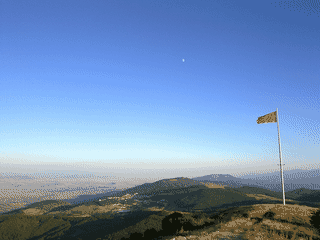

Kruševo
North Macedonia41.37°N 21.23°E · 1,350 m
28 places in the index.
41.37°N 21.23°E · 1,350 m
41.12°N 20.80°E · 700 m
42.00°N 21.43°E · 251 m
41.73°N 22.18°E · 340 m
41.18°N 20.68°E · 675 m
Bitola is a grand old town that bears the marks of its turn-of-the-century importance as a center for diplomacy. It has the most European atmosphere in North Macedonia, with neo-classical buildings, Ottoman architecture, and a lively cafe culture on Širok Sokak.
Atlas entry
Brajčino is a small mountain village of about 160 residents at 1000m altitude, offering an authentic escape from tourist crowds. The village is famous for its five historic churches, one elaborate monastery, and remarkably preserved traditional architecture with homes dating back centuries.
Atlas entry
Debar sits on the north shore of Lake Debar, an artificial lake where the Black Drin and Radika rivers meet. The city of roughly 14,000 people is best known for its thermal mineral spas, which draw Macedonians seeking medical treatments.
Atlas entry
Demir Kapija is a small town in the Povardarie wine region of North Macedonia whose name literally means "Iron Gate" in Turkish, referring to the dramatic canyon that frames the Vardar River. The area draws outdoor enthusiasts for its limestone rock climbing, caving, kayaking, and hiking, while wine lovers visit for the celebrated Popova Kula and Queen Maria Royal wineries perched on surrounding hillsides.
Atlas entry
Dojran is a small lakeside resort town in Eastern North Macedonia that draws visitors seeking relaxation away from crowded tourist routes. The town consists of two settlements: historic Nov Dojran and more built-up Star Dojran, where most hotels and restaurants concentrate along the lakeshore.
Atlas entry
Galičica National Park is a mountainous protected area occupying the ridge between two of the Balkans' most scenic lakes—Ohrid and Prespa—on the border with Albania. The park offers excellent ridge hiking with panoramic views, historic monasteries perched on lake bluffs, and access to Golem Grad island in Lake Prespa.
Atlas entry
Gevgelija is a modest city of about 20,000 residents in the far south of Eastern North Macedonia, sitting directly on the Greek border. It serves as a practical stop for travelers transiting between Macedonia and Greece, but also draws visitors for its thermal spas at Negorci, skiing on Mount Kožuf, and the annual Smokvijada fig festival celebrating the region's largest fig production in the country.
Atlas entry
Kavadarci is widely known as the wine capital of North Macedonia, sitting at the heart of the Tikveš grape-growing region in Povardarie. The city is the principal urban center of the Tikveš area, offering access to centuries-old monasteries, lake scenery, and wine tourism centered around the Tikveš winery.
Atlas entry
Kičevo is a modest regional center of roughly 27,000 residents nestled in a valley on the southeastern slopes of Mount Bistra. The city serves as a practical gateway to western North Macedonia's traditional villages and mountain monasteries.
Atlas entry
Kočani is a small industrial and agricultural city in Eastern North Macedonia, best known as the gateway to Mount Osogovo. The surrounding area offers archaeological sites, medieval towers, and the weekend recreational destination of Ponikva with its ski facilities.
Atlas entry
Kratovo is a town of just under 7,000 residents in northeastern North Macedonia, perched on the western slopes of Mount Osogovo inside an extinct volcano crater. By Macedonian standards, it is not a major tourist destination; by European standards, it is as far off the beaten path as you can get.
Atlas entry
Kriva Palanka is a small mountain town of nearly 15,000 residents in the far northeastern corner of North Macedonia, serving as a gateway to the Bulgarian border. The surrounding Osogovo Mountains hide several medieval monasteries with significant frescoes and architecture, making the area popular for day-trippers interested in religious heritage.
Atlas entry
Kruševo is a mountain town with crisp air and a central place in the story of the Ilinden Uprising. Its brief republic is remembered in national celebrations each August.
Kumanovo is one of North Macedonia's larger cities, located 35 km northeast of the capital Skopje in a long valley. The city is populated by Macedonians, Albanians, Roma, Serbians, Turks, and others, creating a diverse cultural atmosphere.
Atlas entry
Negotino is a town of 13,000 people in the Povardarie region of North Macedonia, forming part of the country's foremost wine-growing region alongside Kavadarci and Demir Kapija. The town offers 19th-century churches, a historic monastery, and a modest museum—making it a quiet stop for travelers interested in Macedonian wine culture and Ottoman-era architecture.
Atlas entry
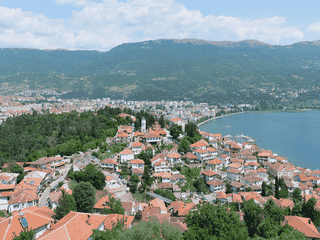
Ohrid pairs ancient churches and monasteries with a scenic lakeside setting. Religious heritage and waterfront scenery shape a visit to the historic town.
Pelister National Park protects Macedonia's third-highest peak and offers a rare alpine wilderness experience in the heart of the Balkans. The park's twin glacial lakes, called Pelister's Eyes, sit at over 2,180 m and require a demanding but rewarding 5-hour hike from Dihovo village.
Atlas entry
Prilep is nicknamed "The city under Marko's towers" for its medieval fortress ruins atop a bare hill. With a population of 76,768, it is Macedonia's tobacco and beer capital — tobacco leaves dry across the city in late summer and fall, and the local brewery produces the country's most popular beers.
Atlas entry
Radoviš is a small Macedonian city of about 16,000 residents in Eastern North Macedonia, known for its proximity to Plačkovica Mountain and mountaineering opportunities. The city draws visitors primarily for the Church of the Holy Trinity, one of the most impressive Orthodox churches built in the Balkans in the 21st century.
Atlas entry
Resen serves as the only town near the Prespa Lakes, which span North Macedonia, Albania, and Greece. The city produces half of North Macedonia's apples, earning it the nickname of the apple capital.
Atlas entry
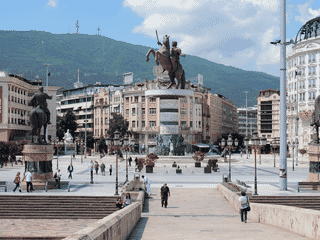
Skopje pairs Ottoman baths and caravanserais in Stara Čaršija with grand neoclassical monuments in Centar. The contrast gives the capital a distinctive architectural character.
Štip's Isar Fortress ruins overlook the meeting of the Bregalnica and Otinja rivers. The surviving walls and a cross form an illuminated landmark after dark.
Struga's flat riverside streets lend themselves to easy walks. Waterside cafes offer places to pause along the way.
Strumica is a well-developed small city of about 40,000 residents serving as the seat of its own municipality in Eastern North Macedonia. The city offers a blend of reconstructed urban spaces like Goce Delčev Square (redesigned in 2010), Ottoman-era architecture, nearby mountain hiking on Belasica, and a reputation as the country's agricultural capital.
Atlas entry
Sveti Nikole is a modest regional center in the Ovče Pole plain, eastern North Macedonia. It serves as a quiet counterpoint to larger cities, with a neoclassical museum, a 1903 clock tower, and access to ancient sites like Bylazora.
Atlas entry
Veles is a city with a rich and varied cultural tradition, home to Macedonia's first theatre, first library, first music school, and first museum. The city sits on hills above both sides of the Vardar River, creating a unique cityscape.
Atlas entry
Vevčani is a small mountain village of about 2,500 people that has cultivated an almost tongue-in-cheek sense of independence, complete with its own "passport" stamps and local currency. The main draw is the Vevčani Carnival, held every January 13th to celebrate the New Year per the Julian calendar—a tradition dating back 1,400 years.
Atlas entry
Vinica is a small city in eastern North Macedonia with fewer than 20,000 residents across the municipality. The city draws visitors for its archaeological significance, particularly the Vinica Terracotta Icons discovered at Viničko Kale, considered among the most important findings in the country.
Atlas entry
In development: the whole atlas offline, a trip planner and a private journal. We'll post here when it ships. No newsletter to join.


