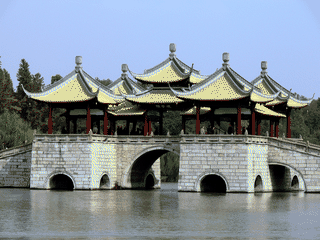

Yangzhou
East Asia · China
Did you know?
- Marco Polo served as governor here for three years in the late 13th century.
- Waterways run from the Grand Canal through neighborhood canals.
- Signature fried rice combines fried egg, muer mushroom, ham, shrimp, scallions, peas, and carrots.
See also
Nanjing
China32.05°N 118.77°E · 15 m
Overview
Yangzhou is a historic canal city where garden walks and waterways meet Huaiyang cuisine. Slow the pace with the Grand Canal Museum, old-town lanes, and a bowl of signature fried rice.
Languages: Chinese
Why go?
Yangzhou is a 2,500-year-old canal city in Jiangsu province, built on flat land just north of the Yangtze River and criss-crossed by waterways from the Grand Canal to neighborhood canals. It developed as a major trading center for salt, rice, and silk—Marco Polo served as governor here for three years in the late 13th century, and the city is the birthplace of former CCP general secretary Jiang Zemin. Today it preserves Ming-era canal contours and several classical gardens (Ge Yuan and He Yuan are highlights), Taoist temples like Daming Temple, and the Muslim tomb of Puhaddin. Unlike nearby Nanjing or Suzhou, Yangzhou sees far fewer foreign tourists, making it a peaceful historical stop for backpackers seeking authentic Huaiyang culture.
Adapted from Wikivoyage contributors · CC BY-SA 4.0
Getting in
Yangzhou has three railway stations: Yangzhou Railway Station (near the city center), Yangzhoudong (Yangzhou East) Railway Station, and Jiangdu Railway Station. The city is on major north-south rail lines connecting to Nanjing (30-50 min), Shanghai (2.5-3 hr), and beyond. Yangzhou Taizhou Airport (YTY) is about 40 km east of the city center, with domestic Chinese flights plus international routes to Osaka Kansai and Seoul Incheon as of 2025. Long-distance buses arrive at Yangzhou Passenger Bus Terminal (near the train station) or Yangzhou East Passenger Bus Terminal. The airport express bus takes 75 minutes from the city center.
Adapted from Wikivoyage contributors · CC BY-SA 4.0
Getting around
City buses are reliable and cheap at typically ¥2 per ride, though many routes end service around 18:00-19:00 with key lines running until 22:00 or last train arrivals. Key east-west routes Z6, K1, and 88 along Wenchang Rd connect the two main railway stations; tourism routes 游1/2/3 connect major tourist spots. Bus schedules and stop lists are posted in Chinese at stops. Rideshare and taxis are widely available, and pedicabs (sanlunche) are common in the old town for leisurely canal-side rides. Bicycling is pleasant with protected lanes on major streets; shared bicycles (like Ofo, Mobike) are ubiquitous in the urban area, though watch for mopeds that disregard traffic laws.
Adapted from Wikivoyage contributors · CC BY-SA 4.0
When to go
Yangzhou has a humid subtropical climate with four distinct seasons. Summer (June-August) is hot and humid with temperatures reaching 32°C and significant rainfall (July gets over 200 mm); this is peak season for Slender West Lake's lotus flowers. Winter is cold (January averages 7°C) with some snow, making canal walks atmospheric but some outdoor attractions limited. Spring (April-May) and autumn (September-October) offer mild weather ideal for garden visits. Note that smaller hotels may close for a few days around Chinese New Year, and hotel rates rise during national holidays when domestic tourists flood the Slender West Lake area. The city has no major international festivals that draw crowds, making it suitable for off-peak visits.
Adapted from Wikivoyage contributors · CC BY-SA 4.0
Where to stay
Unlike many Chinese cities, Yangzhou has little lodging in the train station area (though a Hanting Hotel opened in the new bus station building there). Hotels are concentrated in two main areas: around downtown (near Wenchang Rd and the old city), and near the former main bus station area along Jiangyang Rd and Hanjiang Rd, a few km southwest of downtown. As of 2017, room rates start from around ¥100 in both areas for budget options. Mid-range hotels are available near major tourist sites. During Chinese New Year and other national holidays, expect higher prices and crowds around Slender West Lake.
Adapted from Wikivoyage contributors · CC BY-SA 4.0
Food and drink
Yangzhou is the birthplace of Yangzhou fried rice (扬州炒饭), made with fried egg, muer mushroom (木耳), ham, shrimp, scallions, peas, and carrots—this is the signature dish representing Huaiyang cuisine. Other famous local dishes include Lion's Head (狮子头), a giant pork and crab meatball; Thousand-layer cake (千层糕); steamed dumplings (蒸饺); tofu noodles in chicken soup (大煮干丝); soup-filled dumplings (小笼汤包); and stinky tofu (臭豆腐). For breakfast, look for steamed filled buns (baozi 包子), plain steamed buns (mantou 馒头), rice porridge (zhou 粥), and boiled eggs. Damingsi Vegetarian Restaurant (大明寺素菜馆) at 1802 Wenhui Road East offers vegetable-based versions of local favorites at reasonable prices, affiliated with Daming Temple. Budget around ¥20-50 for a full meal at local restaurants.
Adapted from Wikivoyage contributors · CC BY-SA 4.0
Things to do
The main sights include Ge Yuan (个园), a classical garden representing the four seasons with pavilions, open 07:30-17:00 with student discounts; He Yuan (何园), a scholar's garden with tea houses, open 07:30-18:00; Slender West Lake (瘦西湖), a slim scenic lake with pavilions (¥120 entry); Daming Temple (大明寺), a 5th-century Buddhist temple rebuilt after the Taiping Rebellion, open 08:00-16:45; and Tianning Temple (扬州天宁寺), free admission Tu-Su 09:00-17:00, with a copy of the Siku Quanshu and Buddhist history exhibits. The Yangzhou Museum (free, 08:30-11:00 and 13:00-17:00) displays a Tang dynasty dragon boat salvaged from the Grand Canal. Shi Kefa Memorial honors a Ming general who refused to surrender to the Qing in 1645. Puhaddin Park (free, 08:00-17:00) contains the tomb of a 13th-century Islamic missionary said to be a descendant of Mohammed, with halal eateries nearby.
Adapted from Wikivoyage contributors · CC BY-SA 4.0
Go next
From Yangzhou, the most common onward destinations are Nanjing (30-50 min by train, historical capital with Ming Xiaoling Tomb and Sun Yat-sen Mausoleum), Suzhou (famous for its classical gardens and canals, similar to Yangzhou but larger tourist infrastructure), Huangshan (stunning mountain area with UNESCO-listed peaks and villages), and Gaoyou (a smaller nearby city). Nanjing is the most logical next stop for travelers heading north or continuing an itinerary through Jiangsu province. Shanghai is reachable in 2.5-3 hours by train, making it possible to combine Yangzhou with China's largest city. Bus connections also serve nearby destinations, and Yangzhou's position on the Yangtze River makes river travel an option for adventurous travelers.
Adapted from Wikivoyage contributors · CC BY-SA 4.0
Safety
Yangzhou is generally a safe city for travelers with low violent crime rates. Standard precautions apply: watch your belongings in crowded markets and tourist areas, be cautious of traffic as mopeds often disregard laws, and use registered taxis or rideshare apps. The old city's narrow alleys are pleasant for evening walks but can be poorly lit. Water safety is relevant near canals—stay on marked paths and boardwalks, especially around Slender West Lake and the Xiaoqinhuaihe Canal. Medical facilities exist in the city center, though English-speaking staff may be limited. Like all of China, emergency services can be reached at 120 (medical) and 110 (police), though English communication may be challenging.
Adapted from Wikivoyage contributors · CC BY-SA 4.0
Connectivity
Mobile connectivity in Yangzhou is excellent with all major Chinese carriers (China Mobile, China Unicom, China Telecom) providing 4G coverage throughout the city and 5G in central areas. SIM cards are readily available at airport, train stations, and convenience stores; expect to pay ¥50-150 for a tourist SIM with data packages. Public WiFi is available in hotels, some restaurants, and shopping centers, though speeds and reliability vary. The main communication apps are WeChat and QQ; download these before arrival and set up an account with a local number. Power plugs use Type I (Australia/China style) with 220V/50Hz; international travelers need adapters. English signage is limited outside major tourist sites, so offline Chinese translation apps are helpful.
Adapted from Wikivoyage contributors · CC BY-SA 4.0
Budget
Yangzhou is moderately affordable for backpackers. Local buses cost ¥2 per ride; shared bicycles around ¥1-3 per ride. Street food and basic meals range from ¥10-30; restaurant dinners with local dishes like Yangzhou fried rice run ¥20-50 per person. Entrance fees vary: Slender West Lake ¥120, Ge Yuan and He Yuan around ¥45-50 (with student discounts available), most temples ¥30-45. Museum entrance is often free. Budget accommodation starts around ¥100/night for basic hotels, with mid-range options ¥200-400. A realistic daily budget for a backpacker is ¥150-300 excluding accommodation, or ¥300-600 with a mid-range hotel.
Adapted from Wikivoyage contributors · CC BY-SA 4.0
Day trips
While Yangzhou itself is the primary destination, nearby day trip options include Gaoyou (smaller city with fewer tourist facilities but authentic local life), or exploring the Yangtze River areas. The most popular side trip is to Nanjing (30-50 min by train), which offers the Ming Xiaoling Tomb, Sun Yat-sen Mausoleum, Confucius Temple area, and the historic city wall. Suzhou is also reachable as a long day trip (1-1.5 hours by train) for those wanting to see more classical gardens and canal scenery. Huangshan would require at least an overnight stay to do justice to the mountain area, so it's better planned as a separate destination rather than a day trip from Yangzhou.
Adapted from Wikivoyage contributors · CC BY-SA 4.0
Field guide adapted from Wikivoyage contributors · CC BY-SA 4.0. Text has been adapted and organized for this guide. About our sources.
Places to know
A few starting points from the guide. Check current hours and prices before you go.
- eat
Damingsi Vegetarian Restaurant
Temple-affiliated vegetarian restaurant serving meat-substitute versions of local Huaiyang dishes at reasonable prices
Recorded price: ¥20-40
Adapted from Wikivoyage contributors
- see
China Grand Canal Museum
Recorded price: Free
Adapted from Wikivoyage contributors
- see
Daming Temple
Rebuilt after being destroyed in the Taiping Rebellion, this temple originally dated from the 5th century AD. There is a spring next to the tea house.
Adapted from Wikivoyage contributors
- see
Ge Yuan
Classical garden with four-season sections, pavilions, and rock formations representing each season
Recorded price: ¥45 (student discount available)
Adapted from Wikivoyage contributors
- see
Hanlinyuan Museum
A magnificent tomb for Liu Xu, ruler of the Guangling Kingdom. It is five stories deep, with different levels housing things like a warehouse, living quarters, and a coffin on wheels.
Adapted from Wikivoyage contributors
- see
He Yuan
Scholar's garden cleverly arranged with tea houses, open grottoes, and pleasant views—one of the best gardens in Jiangsu Province
Recorded price: ¥50 (student discount available)
Adapted from Wikivoyage contributors
- see
Lu Shi Yan-shang Zhu-zhai
Lavishly furnished salt merchant's home with 100 rooms, showcasing Qing-era wealthy merchant lifestyle
Adapted from Wikivoyage contributors
- see
Marco Polo Memorial Hall
Exhibition on Marco Polo's journey, more suitable for children than academic historians; no actual artifacts from his time remain
Adapted from Wikivoyage contributors
Before you go
Accommodation
Hotels concentrate around downtown and near the former bus station area. Budget rooms start around ¥100/night as of 2017. Prices rise during Chinese New Year and national holidays.
Connectivity
4G/5G coverage is excellent with major carriers. SIM cards available at airports and stations. WeChat is essential for communication and payments in China.
Food
Yangzhou fried rice (扬州炒饭) is the signature dish; other local specialties include Lion's Head meatball (狮子头), soup dumplings (小笼汤包), and stinky tofu. Budget ¥20-50 per meal at local restaurants.
Money
Chinese Yuan (CNY) is the local currency. ATMs are widely available. Mobile payment via WeChat Pay and Alipay is nearly universal; bring some cash for small vendors and local markets.
Transport
City buses cost ¥2 per ride; key tourism routes 游1/2/3 connect major sights. Shared bicycles (¥1-3) are widely available. Taxis and rideshare apps work well for longer distances.
Weather
Humid subtropical climate; summers are hot (32°C) and rainy (July gets 200+ mm), winters are cold (7°C January). Spring and autumn are best for visiting gardens.