-0_3.jpg)
Vladivostok
Eastern Europe and the Balkans · Russia
Did you know?
- The regional history museum stages a tiger-versus-bear exhibit.
- The Trans-Siberian Railway reaches its eastern terminus here.
- The C-56 submarine is displayed beside the Naval Memorial.
See also
Overview
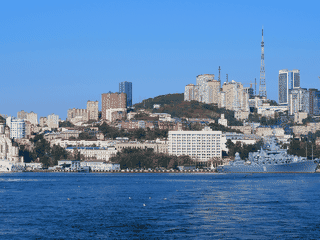
Vladivostok climbs dramatic hills above sheltered bays. Its viewpoints look across the Amursky and Ussuriysky gulfs and Golden Horn Bay.
Languages: Russian
Why Go?
Vladivostok is the eastern terminus of the Trans-Siberian Railway and Russia's largest port on the Pacific Ocean, serving as home to the Russian Pacific Fleet. With 600,000 inhabitants, it is the second-largest city in the Russian Far East after Khabarovsk. The city sits on dramatic hills overlooking Amursky Gulf, Ussuriysky Gulf, and Golden Horn Bay, earning comparisons to San Francisco and Naples. From 1958 to 1992, Vladivostok was off-limits to foreigners; it reopened for tourism after the Soviet Union's fall, giving visitors a frontier city feel with sweeping boulevards of ornate century-old buildings alongside decaying Soviet blocks and new high-rises.
Adapted from Wikivoyage contributors · CC BY-SA 4.0
Getting In
Vladivostok International Airport (IATA: VVO) is 40 km northeast of the city near Artyom and is the largest airport in the Russian Far East, serving over 1.5 million passengers annually. Flights connect to other Russian cities as well as Korea, China, and Japan; domestic flights are relatively cheap while flights to Japan and Korea are more expensive. The iconic Vladivostok Station on Aleutskaya Street marks the end of the Trans-Siberian Railway at kilometer 9288; the beautiful old station building is worth visiting even if you're not boarding a train. Ferries from Japan and Korea also arrive at the overseas passenger terminal.
Adapted from Wikivoyage contributors · CC BY-SA 4.0
Getting Around
Vladivostok's hilly terrain makes walking challenging but rewarding. The city center near the water features sweeping boulevards, while steep hills connect different levels. Public transport includes buses and trams; tramway station "Sportivnaya" serves the Sportivnaya Market and harbor area. Taxis are available, and the recently built bridges across Golden Horn Bay and Eastern Bosphorus strait have dramatically improved traffic flow, with the latter being the world's largest cable-stayed bridge at 3.1 km.
Adapted from Wikivoyage contributors · CC BY-SA 4.0
When to Go
Vladivostok shares latitude with the subtropical resort of Sochi but averages nearly 10 degrees colder due to the Siberian High bringing cold winds from Yakutia. January is cold at -14°C (7°F), while August is warm at 24°C (75°F). Winters are cold, clear, and very windy with scarce snow; temperatures can drop below -30°C in February. August and September bring the most sunny and pleasant temperatures, making them ideal for sightseeing. However, Pacific monsoons can bring multi-day rain at summer's end. The lotus lakes attract campers when flowers bloom in August.
Adapted from Wikivoyage contributors · CC BY-SA 4.0
Where to Stay
Accommodation options range from budget hostels to luxury hotels. Neptunea Hostel Vladivostok on Uborevicha Street offers beds starting from with small breakfast, WiFi, and kitchen facilities. Hostel Optimum on Aleutskaya 17 provides another budget option. Superstar Guesthouse at 8A Admirala Fokina Street, run by a Korean owner, costs slightly more but sits in the most touristic part of the city center. For mid-range options, AZIMUT Hotel Vladivostok on Naberezhnaya Street and A-Hotel Amur Bay offer reasonable rates. The Lotte Hotel Vladivostok at 29 Semenovskaya Street provides luxury with swimming pool, fitness center, and business facilities.
Adapted from Wikivoyage contributors · CC BY-SA 4.0
Food and Drink
Vladivostok's food scene reflects its international port history with strong Japanese and Korean influences. Osama Sushi on Praporschika Komarova Street serves pan-Asian cuisine with nice sushi and fantastic bibimbap. Moloko & Med on Suhanova Street offers European cuisine in a stylish atmosphere popular with foreigners, with English-speaking staff and menu. For German food and house-brewed beer, try Hans on Fokina Street or München in the basement on Svetlanskaya. Supra specializes in excellent Georgian cuisine. Club Cuckoo at Okeanskiy Prospect transforms from a restaurant serving contemporary European cuisine by chef Adriano Cavalieri (from Melbourne) into the city's most glamorous nightclub on weekends.
Adapted from Wikivoyage contributors · CC BY-SA 4.0
Things to Do
Sportivnaya Harbor offers a popular summertime promenade and beach with an amusement park and 80m Ferris wheel. The Arsenyev Regional History Museum at 20 Svetlanskaya Street features natural history displays and a famous tiger-versus-bear death-dance exhibit. The Museum Vladivostok Fortress at 4-a Batareynaya Street overlooks the sea with displays of defused bombs and military vehicles. Visitors can explore the C-56 WWII submarine parked by the Naval Memorial on Korabelnaya embankment. The Zarya Center for Contemporary Art offers free entry. Russkiy Island, connected by two bridges, provides swimming, sun-bathing, and biking; the Voroshilovskaya Battery former Soviet defensive complex is now a museum there.
Adapted from Wikivoyage contributors · CC BY-SA 4.0
Safety
Some roads can only be crossed via poorly-lit underground passageways, which can be unsettling at night. Beggars tend to congregate near these passageways, including children with quick hands, so secure your pockets. While locals strip down for swims on the Naberezhnaya boardwalks, be aware of rusted metal; stick to designated beaches unless you're confident in your tetanus protection. Overall, Vladivostok is relatively safe for travelers, but standard urban precautions apply.
Adapted from Wikivoyage contributors · CC BY-SA 4.0
Connectivity
The main post office is located across Aleutskaya Street from the train station, with internet access available on the first floor. Several internet cafes operate in the town center, including Interface on Semyonovskaya Street and Monte-Carlo on Fokina Street, both open day and night. ATMs are easy to find and connected to international bank networks. Many hotels have exchange desks, though rates may favor the hotel; banks offer the most reliable currency exchange. Dodgy money-changers near Sportivnyaya Harbor should be approached with caution.
Adapted from Wikivoyage contributors · CC BY-SA 4.0
Go Next
The Trans-Siberian Railway provides the main exit route, heading west toward Moscow or into China. The next major stop is Khabarovsk, approximately 700 km (435 mi) away. Smaller Ussuriysk offers connections to China for eager travelers. Nakhodka makes for an interesting side trip. Air Koryo offers flights from Vladivostok to Pyongyang, North Korea. The routebox shows Khabarovsk as the western major destination with Ussuriysk as a minor stop, while eastbound the route ends at Vladivostok.
Adapted from Wikivoyage contributors · CC BY-SA 4.0
Field guide adapted from Wikivoyage contributors · CC BY-SA 4.0. Text has been adapted and organized for this guide. About our sources.
Places to know
A few starting points from the guide. Check current hours and prices before you go.
- sleep
A-Hotel Amur Bay Vladivostok
Also managed by the AZIMUT group, but cheaper.
Adapted from Wikivoyage contributors
- sleep
AZIMUT Hotel Vladivostok
This is the new name for Hotel Vladivostok.
Recorded price: RUB
Adapted from Wikivoyage contributors
- eat
8 Minut Stolovaya
A buffet restaurant
Adapted from Wikivoyage contributors
- eat
Café Cuckoo
This nightclub also offers contemporary European cuisine for lunch and dinner. The head chef, Adriano Cavalieri, came from Melbourne, Australia. There is outdoor and indoor seating for approximately 100 people.
Adapted from Wikivoyage contributors
- eat
Hans
German food and house-brewed beer of three colours: red, light and dark served in medieval setting. The first floor is a fireplace hall, the second floor is made for dance and filled with live music. Comprises 60 and 100 visitors respectively.
Recorded price: RUB
Adapted from Wikivoyage contributors
- eat
Moloko & Med
European cuisine in a very nice and stylish atmosphere very popular with foreigners and expats. The staff speak English and an English-language menu is available. There is also a selection of Russian dishes on the menu. There are outdoor and indoor seating areas.
Adapted from Wikivoyage contributors
- eat
München
German food and house-brewed wheat beer of three colours: red, light and dark served in a quasi-medieval setting like in Hans.
Recorded price: RUB
Adapted from Wikivoyage contributors
- eat
Osama Sushi
Pan-Asian restaurant, Japanese and Korean cuisine. Nice sushi and fantastic bibimbap, sake and soju.
Recorded price: RUB
Adapted from Wikivoyage contributors
Before you go
Connectivity
Internet available at the main post office and several cafes. ATMs and international bank networks are easily found throughout the city.
Culture
Vladivostok has a frontier city feel with hilly streets, ornate century-old buildings, and Soviet-era blocks. The city was off-limits to foreigners from 1958-1992.
Money
ATMs are widely available and connected to international networks. Banks offer the most reliable currency exchange. Some hotels have exchange desks with potentially unfavorable rates. Russian Ruble (RUB) is the local currency.
Safety
Use underground passageways with caution at night due to poor lighting and beggars. Watch for rusted metal on boardwalks. Standard urban precautions apply.
Transport
Vladivostok International Airport is 40 km northeast near Artyom. The Trans-Siberian Railway ends at Vladivostok Station on Aleutskaya Street. Bus 29d from Izumrud bus station serves Russkiy Island.
Weather
January averages -14°C with possible -30°C cold spells; August averages 24°C. August-September offer the best weather. Winters are cold, clear, and very windy.