
Szczecin
Eastern Europe and the Balkans · Poland
Did you know?
- Paszteciki are deep-fried filled pastries commonly paired with red beetroot soup.
- Wały Chrobrego is a promenade overlooking the Oder and the port.
- The Pomeranian Dukes Castle houses a museum as well as cafés and restaurants.
See also
Overview
Szczecin's castle, reconstructed Old Town and riverfront promenade offer a varied urban walk. Wały Chrobrego looks over the Oder and the port.
Languages: Polish
Why go?
Szczecin is a maritime port city and capital of Zachodniopomorskie in northwestern Poland, with a population of over 400,000. The city stands out for its unusual urban planning: many roundabouts and wide avenues rebuilt in the 1880s using designs by Georges-Eugene Haussmann, the same architect who designed Paris boulevards. It is one of Poland's seven largest metropoles and third-largest port, though it sits on the Oder River 20 km south of the Baltic Sea rather than on the coast. Szczecin is sometimes considered one of the most liberal Polish cities and was, with Gdańsk, one of the birthplaces of the Solidarity movement in the 1980s. Many visitors are unaware of its architectural attractiveness.
Adapted from Wikivoyage contributors · CC BY-SA 4.0
Understand
Szczecin has a complex history shifting between Poland, Denmark, Sweden, Prussia, and Germany. The place was first mentioned in the 1st century by Roman historian Tacitus. Western Slavic Pomeranians built a stronghold in the 8th century. The town was incorporated into Poland around 1080, received city rights in 1243, and joined the Hanseatic League in 1278. From the 17th century it passed through Swedish, Prussian, and briefly French control before becoming part of Germany in the 18th century, serving as the 'port of Berlin'. World War II bombing destroyed the city centre, Old Town, and industrial areas. After the 1945 Soviet invasion, Poland annexed lands up to the Oder River, expelling the German population. The maritime industry remains strong with a busy port and shipyard, and Szczecin is a centre of service industries.
Adapted from Wikivoyage contributors · CC BY-SA 4.0
Getting in
Szczecin is located in northwestern Poland very close to the German border, making it easier to reach from parts of Germany, notably Berlin, than from much of Poland. Solidarity Szczecin–Goleniów Airport (IATA: SZZ) is located almost 50 km from the city centre near Goleniów, operated by LOT and some low-cost airlines. Szczecin Główny is the main railway station. The Szczecin bus station is the main stop for Flixbus, with rail replacement buses to Angermünde also departing from here. The Szczecin DA PKS bus station operates daily connections with Schwedt in Germany.
Adapted from Wikivoyage contributors · CC BY-SA 4.0
Get around
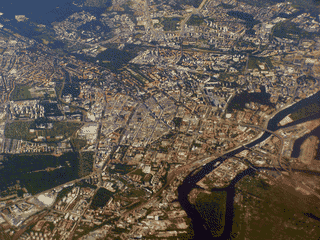
Szczecin is split into two parts named after their location on banks of the Oder River: Lewobrzeże (left bank) and Prawobrzeże (right bank), with the port in between. The city centre and most attractions are situated in Lewobrzeże. The city has many roundabouts and wide avenues designed in Haussmann's style, still used for newly built areas.
Adapted from Wikivoyage contributors · CC BY-SA 4.0
When to go
Szczecin can be visited year-round, though summer (June-August) offers the best weather for exploring parks and waterways. The summer fountain show at Teatr Pleciuga runs daily at 21:30 from late May through summer, lasting 30 minutes. Winter visits offer fewer tourists but shorter daylight hours for sightseeing.
Adapted from Wikivoyage contributors · CC BY-SA 4.0
Where to stay
Accommodation options in Szczecin range from budget hostels to mid-range hotels. CUMA youth hostel (Szkolne Schronisko Młodzieżowe) on ul. Monte Cassino 19a offers dorm beds from around 40 zł. Mid-range options include Hotel Arbet (Piesza 11), Hotel Migrand (Robotnicza 28/29), and Campanile Hotel Szczecin (Ul. Wyszyńskiego 30). For higher-end stays, Radisson BLU (Plac Rodła 10), Novotel (Al.3 Maja 31), and Hotel Dana (Aleja Wyzwolenia 50) are available.
Adapted from Wikivoyage contributors · CC BY-SA 4.0
Food and drink
Szczecin's unique local snack is paszteciki (singular: pasztecik), deep-fried pastry with meat or cheese and mushroom filling, best eaten hot with a cup of barszcz czerwony (red beetroot soup). Fast food options including hamburgers, hot dogs, kebabs, and pizza are widely available. For local Polish cuisine, Browar Stara Komenda (plac Stefana Batorego 3) serves excellent żurek (sourdough soup) and pork neck with pickled cucumbers from 42 zł for mains. Vegan and vegetarian options include Amar (Śląska 9) offering affordable danie dnia (dish of the day) and zupa dnia (soup of the day). The majority of pubs and bars are in the old town (Stary Rynek) or around ul. Bogusława, with large beers costing 6-8 zł and 50-ml vodka shots around 6 zł.
Adapted from Wikivoyage contributors · CC BY-SA 4.0
Things to do
The Pomeranian Dukes Castle (Zamek Książąt Pomorskich) houses a museum, restaurants, cafes, and a tourist information office. The Old Town (Stare Miasto), jokingly called 'Brand New Old Town' because reconstruction only started in the late 1990s and is ongoing, features rebuilt houses and the Old Town Hall museum. Wały Chrobrego (Hakenterrasse) is a promenade with views of the Oder river and port, housing the Muzeum Morskie maritime museum. St. Jacob's Cathedral (Katedra św. Jakuba) is a large Gothic structure. Cmentarz Centralny is the third-largest cemetery in Europe. For history enthusiasts, the S-1 blast and fallout shelter (entry 15 zł) is Poland's largest, offering World War II or Cold War tours. Pionier Cinema (est. 1909) is the oldest cinema in the world still in operation. Sports fans can watch Pogoń Szczecin play in Ekstraklasa, Poland's top football league, at Floriana Krygiera Municipal Stadium (capacity 21,163) located 2 km northwest of the city centre.
Adapted from Wikivoyage contributors · CC BY-SA 4.0
Connectivity
As of August 2022, Szczecin and its approach roads have 4G coverage from Orange, Play, and T-Mobile, and 5G from Plus. You might also pick up German mobile carriers near the border. WiFi is widely available in public places.
Adapted from Wikivoyage contributors · CC BY-SA 4.0
Stay safe
Szczecin used to be infamous in Poland for organized crime, but these days are long gone with nearly all gangsters dead or in prison. The city is now very safe, though you should stay away from some 'bad' suburbs like Gocław, especially after dark. Be careful when crossing streets as jaywalking is a crime in Poland and police often wait for tourists crossing on red lights. If stopped, claim your money and passport are in your hotel.
Adapted from Wikivoyage contributors · CC BY-SA 4.0
Day trips
On the mainland, Police (with its Jasienica district) shares public transport with Szczecin and features medieval monuments, a marina, and WWII ruins of Hydrierwerke synthetic petroleum factory. Kamień Pomorski and Kołobrzeg are sea resorts with medieval towns. Trzęsacz has Gothic church ruins. Stargard Szczeciński is a medieval town with a cathedral over 100 metres high. Międzyodrze (Lower Oder valley) is a picturesque marsh area full of wildlife. Nowe Warpno and Trzebież are quiet medieval towns with marinas. On Wolin Island: Woliński National Park, wisent game reserve, 93-metre Gosan cliff, Kawcza Góra Mountain, and sea resorts including Świnoujście, Dziwnów, and Międzyzdroje.
Adapted from Wikivoyage contributors · CC BY-SA 4.0
Go next
From Szczecin, you can easily reach the Baltic coast resorts of Kołobrzeg and Świnoujście, medieval towns like Stargard Szczeciński and Kamień Pomorski, and natural areas including Wolin Island and the Lower Oder valley. The city is well-connected to Berlin by bus and train, making it accessible as part of a Poland-Germany itinerary.
Adapted from Wikivoyage contributors · CC BY-SA 4.0
Field guide adapted from Wikivoyage contributors · CC BY-SA 4.0. Text has been adapted and organized for this guide. About our sources.
Places to know
A few starting points from the guide. Check current hours and prices before you go.
- eat
Akademia Kulinarna
Adapted from Wikivoyage contributors
- eat
Amar
Vegan & vegetarian. If you are on limited budget, order their "danie dnia" (dish of a day) and/or "zupa dnia" (soup of a day) which are always very affordable.
Adapted from Wikivoyage contributors
- eat
Bombay
Indian food.
Adapted from Wikivoyage contributors
- eat
Browar Stara Komenda
Brewery/bar that is popular with young locals for a drink, but also a great place for Polish food: Excellent żurek (sourdough soup) and pork neck with pickled cucumbers are to be found here, among other dishes.
Recorded price: From 42 zł (mains)
Adapted from Wikivoyage contributors
- eat
Colorado
Adapted from Wikivoyage contributors
- eat
Columbus
Adapted from Wikivoyage contributors
- eat
Karczma Polska
Adapted from Wikivoyage contributors
- eat
Public Fontanny
Hip restaurant with a cosy atmosphere and modern European cuisine, more akin to what one would find in Berlin. The food is tasty and the staff friendly – a good choice if you're craving for something different.
Recorded price: From 19 zł (bagels)
Adapted from Wikivoyage contributors
Before you go
Connectivity
4G coverage from Orange, Play, and T-Mobile; 5G from Plus. WiFi widely available in public places. Consider a local SIM card for data.
Culture
Szczecin was historically German (Stettin) and retains some Germanic architectural influence alongside Polish culture. It is considered one of Poland's most liberal cities.
Language
Polish is the official language. English is understood in tourist areas, hotels, and by younger people. German is also useful given the proximity to Germany.
Money
Poland uses the złoty (PLN). Credit cards are widely accepted in hotels, restaurants, and shops. Cash can be withdrawn from numerous ATMs throughout the city. Prices are generally lower than Western Europe.
Safety
Szczecin is now very safe. Organized crime is a thing of the past. Avoid Gocław suburb after dark. Jaywalking is illegal and police enforce it.
Transport
Szczecin has an extensive public transport network of trams and buses. The city centre and most attractions are in Lewobrzeże (left bank). Taxis and rideshare apps are available.