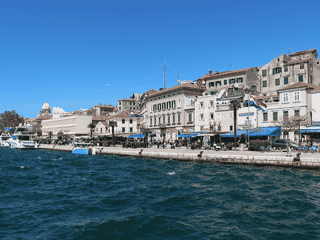

Šibenik
Eastern Europe and the Balkans · Croatia
Did you know?
- An orange-and-black traditional cap serves as a civic symbol.
- The cathedral exterior features 72 carved human heads.
- Dalmatian klapa singing can be heard at venues along Kalelarga.
See also

Split
Croatia43.51°N 16.44°E · 0 m
Overview
Šibenik pairs a stone cathedral with Venetian-era fortresses and Dalmatian houses. Its historic center offers a distinctive setting for a coastal stay focused on architecture.
Languages: Croatian
Why go?
Šibenik is the oldest native Croatian town on the eastern Adriatic, first mentioned in 1066. The city is famous for Saint James Cathedral, a UNESCO World Heritage site built entirely in stone without binder between 1431-1536. The old town features Venetian-era fortresses, centuries-old Dalmatian stone houses, and the traditional orange-and-black Šibenik hat as the city's symbol. Notable locals include parachute inventor Faust Vrančić, basketball legend Dražen Petrović, and pianist Maksim Mrvica.
Adapted from Wikivoyage contributors · CC BY-SA 4.0
Get in
Šibenik is well connected by bus to Croatia, surrounding countries, and Central Europe including Dortmund and Ljubljana. The bus station (Autobusni kolodvor Šibenik) operates 07:00-22:00 with left luggage service available. Local ferries operate from the ferry quay to Kaprije, Prvic Luka, Sepurine, Vodice, Zirje, and Zlarin. The railway station (Kolodvor Šibenik) connects via the Šibenik-Perković line to Split and Zagreb, though trains are quite slow.
Adapted from Wikivoyage contributors · CC BY-SA 4.0
Get around
The old town is walkable, with the main pedestrian street Kalelarga (officially King Tomislav's street) running through the historic center. Taxis and local buses serve the wider city area. Cycling along Kanal sv. Ante is a popular activity with dedicated routes.
Adapted from Wikivoyage contributors · CC BY-SA 4.0
When to go
Summer (June-August) brings beach-goers to nearby Jadrija, Solaris, Žaborić, Grebaštica, Brodarica, and Srima. Visiting in late September offers access to the Medieval festival where medieval-themed goods can be purchased. The shoulder seasons (May-June, September-October) offer milder weather for sightseeing with fewer crowds.
Adapted from Wikivoyage contributors · CC BY-SA 4.0
Where to stay
Private accommodation in Šibenik is less developed than in other Croatian cities, with fewer "sobe" (room) signs visible. A hostel called Indigo is located in the old part of the city. Budget travelers should book ahead during peak summer season as options are more limited compared to neighboring destinations.
Adapted from Wikivoyage contributors · CC BY-SA 4.0
Food and drink
Kike Pizzeria in the ancient part of the city is worth a visit for pizza. Dalmatian klapa singing performances can be enjoyed at venues along Kalelarga. Local specialties include seafood, olive oil, and dry figs. The medieval monastery garden has a quiet cafe with views of the old town and sea.
Adapted from Wikivoyage contributors · CC BY-SA 4.0
Things to do
The Cathedral of St. James (Katedrala sv. Jakova) costs €2 and is open 9:30-18:30, featuring 72 carved human heads on its exterior. St. Michael's Fortress (Tvrđava sv. Mihovila) sits 70m above sea level with panoramic views for €3. Beach activities include picigin, a traditional ball game from Split, played at shallow sandy beaches. Nightlife options include Hacienda club in Vodice (15 minutes by car) and Aurora club in Primošten (30 minutes by car).
Adapted from Wikivoyage contributors · CC BY-SA 4.0
Safety
Šibenik is generally a safe city for travelers. The sea in Šibenik bay itself is not very clean, so visitors prefer the beaches in surrounding areas like Jadrija and Solaris. Standard urban precautions apply in the old town at night.
Adapted from Wikivoyage contributors · CC BY-SA 4.0
Connectivity
As of September 2021, Šibenik and the coastal highway have 4G coverage from A1 and Tele2, and 5G from T-Mobile. WiFi is widely available in cafes, restaurants, and accommodations throughout the city.
Adapted from Wikivoyage contributors · CC BY-SA 4.0
Buy
Kalelarga (King Tomislav's street) offers shops, squares, and cafes. Traditional Dalmatian klapa singing CDs make unique souvenirs. Nearby islands Krapanj and Zlarin are famous for sponge and coral jewelry respectively, dating back to the 17th century. The traditional orange-and-black Šibenik hat costs more than €20, so consider buying a mini replica instead. Olive oil and dry figs are quality local products. The Dalmare shopping mall on the southern outskirts includes major European clothing chains, a Konzum supermarket, and a 24-hour McDonald's.
Adapted from Wikivoyage contributors · CC BY-SA 4.0
Go next
Krka National Park features breathtaking waterfalls, flora, fauna, and historical remains. Kornati National Park is famous for its numerous islands and diving opportunities. Telašćica Nature Park sits adjacent to Kornati. Zadar and Split are easily reachable by bus or ferry for further exploration of the Dalmatian coast.
Adapted from Wikivoyage contributors · CC BY-SA 4.0
Field guide adapted from Wikivoyage contributors · CC BY-SA 4.0. Text has been adapted and organized for this guide. About our sources.
Places to know
A few starting points from the guide. Check current hours and prices before you go.
- sleep
Hostel Indigo
Hostel located in the old part of the city
Adapted from Wikivoyage contributors
- eat
Kike Pizzeria
Pizzeria worth visiting in the ancient part of the city
Adapted from Wikivoyage contributors
- see
Biskupska palača
(1439-1441)
Adapted from Wikivoyage contributors
- see
Crkva i smostan sv. Frane
Dating from the 16th century.
Adapted from Wikivoyage contributors
- see
Crkva sv. Barbare
A beautiful small church dating from the 15th century with an asymmetric facade with a clock. Now it houses the Muzej crkvene umjetnosti (Museum of Church Art).
Adapted from Wikivoyage contributors
- see
Gradska vijećnica
Formerly known as Plathei Communis, it was built from 1533-1536.
Adapted from Wikivoyage contributors
- see
Katedrala sv. Jakova
This basilica is considered as one of the major attraction in the city. It is on the UNESCO World Heritage list. Construction started in 1431, and it was not finished until 1536 due to Turkish wars. Several successive architects built it completely in stone in the 15th and 16th centuries, both in Gothic and in Renaissance style. The interlocking stone slabs of the Cathedral's roof were damaged when the city was shelled by Serbian forces in 1991. The damage has since been repaired. It has a beautiful baptistery worth seeing it, and the curiosity is it has been built with stone only, without any kind of binder. Another one is 72 human heads carved in stone on the external part which belong to unknown individuals, passers-by, sailors, merchants and peasants who posed as the cathedral was being built. Statues of Adam and Eve are also curious; Adam is covering his breasts, and Eve is covering not her breasts, but her stomach.
Recorded price: €2
Adapted from Wikivoyage contributors
- see
Kneževa palača
Adapted from Wikivoyage contributors
Before you go
Connectivity
4G available from A1 and Tele2; 5G from T-Mobile as of September 2021. WiFi widely available in cafes and accommodations.
Money
Croatia uses the Euro (EUR) as of 2023. ATMs are available throughout the city. Credit cards are accepted at most hotels and restaurants.
Safety
Generally safe city; sea in Šibenik bay is not very clean so use beaches in surrounding areas like Jadrija and Solaris.
Transport
Šibenik bus station connects to Croatia, neighboring countries, and Central Europe. Ferries serve nearby islands including Kaprije, Prvic Luka, Vodice, Zirje, and Zlarin.
Weather
Summer months (June-August) are hot and busy with beach visitors. Shoulder seasons offer milder weather ideal for sightseeing.