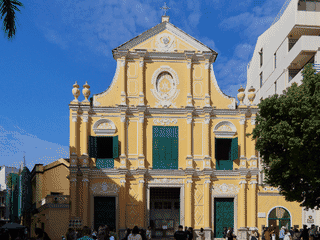
Overview
Macau layers Portuguese colonial history and Chinese-language life with legal casinos and a distinctive food culture. The old city’s Portuguese-looking streets and Chinese signage reward slow wandering.
Architecture · Food · History · Culture · Nightlife
Did you know?
- Bacalhau, egg tarts, and serradura reveal the Portuguese-Chinese fusion on the plate.
- Hong Kong is 40 minutes by HZMB bus or 60 minutes by ferry.
- The old center can look Mediterranean even as Chinese-language signs anchor the scene in East Asia.
Why Go
Macau is a former Portuguese colony returned to Chinese rule in 1999, now a semi-autonomous Special Administrative Region. Best known as a major gambling destination where casinos are legal (the only part of China where this is permitted), Macau overtook Las Vegas as the world's highest revenue gambling destination around 2008. Beyond gambling, the city offers gorgeous colonial architecture, some on the UNESCO World Heritage List, a lovely climate, fine beaches, and excellent Portuguese-Macanese fusion cuisine.
Understand
As the first and last European colony in East Asia, Macau has more visible colonial history than Hong Kong. The buildings and cobblestone or patterned brick streets in many parts of the city, particularly the center of the old city and Coloane, look much like somewhere in Mediterranean Europe. However, the people and Chinese-language signage indicate Asia. Macau operates under a 'One Country, Two Systems' principle, retaining most laws and governing structures from colonial times, with its own border control, currency, legal system, and postal service.
Talk
Macau's official languages are Cantonese and Portuguese. Cantonese is the main language spoken, similar to Hong Kong and Guangzhou but with unique local slang. Mandarin is becoming more widely spoken, having been compulsory in all government schools since the handover, and is the second most useful language. English is spoken by most front-line staff in the tourism industry, and nearly all museums and casinos have staff with excellent English. Portuguese is less useful for communication as only about 2.3% of the population is conversant in it, but helps with place names and signs. All government signs are bilingual in traditional Chinese and Portuguese, with many tourist signs also in English.
Get In
Macau is accessible by air through Macau International Airport, by ferry from Hong Kong (40-60 minutes), via the Hong Kong-Zhuhai-Macau Bridge (HZMB) bus, and through multiple border crossings including Portas do Cerco, Qingmao Port, Lotus Bridge, and Hengqin Port. The article notes Macau is becoming a low-cost airline hub, with some travelers now arriving in Macau to later go to Hong Kong.
Get Around
Unlike in mainland China, Google Maps is not blocked and can be used in Macau. However, Macau's street views in Google Maps have not been updated since 2008, so they are very outdated. Local transport options include buses with free WiFi, taxis, and the public transport system.
See
Macau is packed with churches, temples, fortresses, and old buildings bearing an interesting mix of Portuguese and Chinese characteristics. The old part of Macau features hundreds of narrow alleyways forming a maze. Key attractions include a statue of the Bodhisatta Avalokitesvara near the Sands Casino and MGM Grand, the Macau Tower for views and adventure sports, and Fisherman's Wharf for theme-park activities and shopping. Most attractions are in Macau Peninsula, but Taipa and Coloane also draw hordes of visitors. The Cotai Strip features The Venetian (largest casino in the world with Venice-styled shopping mall and canals) and City of Dreams.
Eat
Macau is famous for Portuguese and Macanese cuisine. Portuguese food is hearty and straightforward fare, with typical dishes including bacalhau (salted cod), caldo verde (potato and kale soup with chouriço sausage), feijoada (kidney-bean stew), pastéis de nata (egg tarts), and serradura (sawdust pudding). Macanese food is a fusion of Portuguese and Chinese influences with spices from Africa, India, and Southeast Asia. Notable dishes include galinha à africana (African-style chicken with piri-piri sauce), galinha à portuguesa (Portuguese-style chicken in coconut curry), pato de cabidela (duck stew with blood and herbs), minchi (minced pork with potatoes and onions), pork chop bun, almond cookies, and beef jerky. Fernando's on Coloane's Hac Sa Beach is the best-known Macanese restaurant.
Drink
The legal drinking age in Macau is 18. Reasonably priced Portuguese wine is widely available, with a glass in a restaurant around MOP$20, and bottles starting from under MOP$100. Vinho verde pairs well with salty Macanese food. Macau Beer and San Miguel are widely available. There is a buzzing nightlife scene along Avenida Sun Yat Sen near the Kum Iam Statue and Cultural Centre. Locals, especially younger people, prefer western style cafes or places serving 'bubble tea' (tea with tapioca balls, served hot or cold). Casinos offer performances of international level with comprehensive shopping malls.
Sleep
The bulk of Macau's hotels are on the Peninsula, with many options also on Taipa and the Cotai Strip. Coloane has fewer and quieter options, including the beachside Pousada de Coloane. Hotel rates are most expensive on Friday and Saturday nights. Booking through a travel agent, even for same day, can yield substantially lower rates than walk-in rates. Package deals including return ferry tickets from Hong Kong offer the best prices. Note that hotel 'saunas' in the Inner Harbour area are frequently fronts for commercial sex services rather than genuine spa facilities.
Connect
Macau's international dialing prefix is 853. Free public WiFi is provided by WiFi Go under the network 'FreeWiFi.MO by WiFiGo' - some hotspots provide 24-hour service, others are 8AM to 1AM. CTM-WIFI limits daily login time. Free WiFi is also provided on public buses, and some hotels/casinos offer WiFi even for non-guests. Unlike mainland China, the internet is not censored in Macau and all websites are accessible. Tourist information offices on Largo do Senado and at the jetfoil terminal have maps, museum and event information, English-speaking staff, and free Internet access.
Stay Safe
Binge-drinking or drunken behavior is not tolerated in Macau. Politics is generally less sensitive than in Hong Kong with no active independence movement. The extreme temperature change between 35°C humid summer weather outdoors and 18°C air-conditioned buildings can cause cold symptoms; carrying a long-sleeve item is advisable. While tap water is safe to drink, locals typically boil or filter it due to taste. There have been some cases of dengue fever.
Stay Healthy
One unexpected cause of sickness is the extreme temperature change between 35°C (95°F) humid summer weather outdoors and 18°C (65°F) air-conditioned buildings. While tap water is safe to drink (taste aside), most locals boil or filter their water or buy bottled water. Due to the region's history with SARS and avian flu (H5N1), good personal hygiene is strongly advisable. Macau's healthcare system is adequate for routine consultations, but complicated issues require referral to Hong Kong. There have been some cases of dengue fever, so mosquito repellent and long clothing at dusk are recommended.
Respect
Social etiquette in Macau is very similar to Hong Kong. People are generally friendly to foreigners due to hundreds of years of Portuguese colonial rule. However, do not assume locals speak English or Portuguese; a few essential Cantonese phrases are always helpful. Unlike Hong Kong, locals have largely fully embraced the 'Chinese' identity, and the use of Mandarin is not politically charged. Politics is generally less sensitive than in Hong Kong.
Go Next
From Macau, Hong Kong is 40 minutes by HZMB bus or 60 minutes by ferry. Zhuhai is just across the border in mainland China (most nationalities require a visa). All cities of the Pearl River Delta are a few hours by train, bus, or ferry away. Taipei and other Taiwan destinations are accessible with about 15 daily flights (2 hours).
Work
Non-residents wishing to take up employment in Macau need to obtain a valid work permit and are issued the 'Blue Card' (Non-Resident Worker's Permit). The process takes approximately one month for the work permit and another 1-2 months for the Blue Card. Illegal workers are liable to a maximum fine of MOP$10,000, and authorities crack down severely on offenders.
Budget
Daily budget estimates for backpackers: street food meals cost 30-50 MOP, Portuguese wine is around MOP$20 per glass, Portuguese wine bottles start from under MOP$100, budget accommodation starts from around MOP$200-300 per night, internet cafes charge MOP$5 per hour. Weekend hotel rates are higher than weekday rates.
Guide text adapted from Wikivoyage contributors under CC BY-SA 4.0.
Where to start
Eat
Chinoy Express
Cheap and fast internet cafe near Rua da Felicidade with MOP$5/hour rates.
Price when recorded: MOP$5/hr
Eat
Fernando's
Best-known Macanese restaurant on Hac Sa Beach in Coloane, specializing in seafood and barbecue.
See
A-Ma Temple
Ancient Taoist temple dedicated to the goddess Mazu, one of the oldest in Macau.
See
City of Dreams
Major integrated resort with high-end fashion shops, three hotels, and the world's most expensive theatre show.
See
Fisherman's Wharf
Theme-park style complex with entertainment, shopping, and dining along the waterfront.
See
Largo do Senado
Historic colonial square with Portuguese cobblestone paving and neoclassical buildings.
See
Macau Tower
Observation tower with panoramic views and adventure sports including bungee jumping.
See
Penha Church
Hilltop 17th-century church with panoramic views over the city and harbour.
Before you go
Connectivity
Free public WiFi available via 'FreeWiFi.MO by WiFiGo' and on public buses. Internet is uncensored unlike mainland China. International prefix is 853.
Culture
Portuguese and Cantonese are official languages. English spoken by tourism industry staff. Locals are friendly to foreigners accustomed to Western presence.
Food
Famous for Macanese and Portuguese cuisine including pastéis de nata, bacalhau, and African chicken. Fernando's on Coloane's Hac Sa Beach is the best-known Macanese restaurant.
Health
Dengue fever cases reported; use mosquito repellent especially at dusk. Temperature extremes between outdoors (35°C) and air-conditioned spaces (18°C) can cause illness.
Money
Macau uses the Macau Pataca (MOP). Portuguese wine is reasonably priced, with glasses around MOP$20 and bottles from under MOP$100.
Safety
Binge-drinking and drunken behavior not tolerated. Exercise caution with 'sauna' establishments in Inner Harbour area as some are fronts for sex services.
Transport
Access via ferry from Hong Kong (40-60 min), HZMB bus (40 min), or flight. Google Maps works in Macau but street view is outdated since 2008.