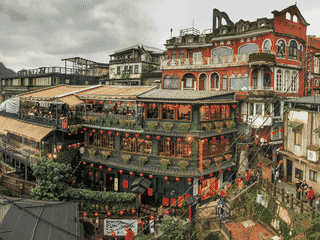

Jiufen
East Asia · Taiwan
Did you know?
- One lane winds along the slope; the other is famous for its steep stone steps.
- The Wufan Tunnel was excavated in 1927 and sealed in 1971 for safety.
- Grandma Lai's Yuyuan serves taro balls on Jishan Street from 08:00 to 20:00.
See also
Taipei
Taiwan25.05°N 121.54°E · 10 m
Overview
Jiufen is a preserved gold-mining village in Taiwan's northeast hills, known for lantern-lined lanes, tea houses, and taro-ball desserts. Its atmospheric alleys and Pacific panoramas make a compact half-day visit with a strong sense of mining history.
Languages: Chinese
Why Go?
Jiufen is a charmingly preserved gold mining village tucked into the hills above Taiwan's northeast coast. Its narrow, lantern-lined streets of tea houses, souvenir stalls, and taro-ball dessert shops evoke a bygone era that made it famous in the film 'A City of Sadness' and led to persistent (if unconfirmed) rumors it inspired Studio Ghibli's 'Spirited Away.' The town delivers atmospheric alleyways, Pacific Ocean panoramas from teahouse terraces, and a tangible sense of history without requiring more than a half-day visit.
Adapted from Wikivoyage contributors · CC BY-SA 4.0
Getting In
From Taipei, the easiest options take roughly the same travel time. Take a TRA train from Taipei to Ruifang (runs every 15-20 minutes), then transfer to a bus for the remaining journey to Jiufen. Alternatively, take a train to Keelung and catch a bus from there. Direct buses to Jiufen also operate from Taipei for those preferring a single connection.
Adapted from Wikivoyage contributors · CC BY-SA 4.0
Getting Around
Jiufen's main historic commercial district is compact enough to explore on foot, though the terrain includes significant elevation changes as the town climbs the hillside. The two main pedestrian streets are Jishan Street (基山街), which winds along the slope, and Shuqi Street (豎崎路), famous for its steep stone steps. The primary bus stop sits at the east end of Jishan Street. The best approach is simply to arrive, disembark, and wander without a strict plan.
Adapted from Wikivoyage contributors · CC BY-SA 4.0
When to Go
Jiufen attracts heavy tour-bus crowds, particularly on weekends and after noon when day-trippers arrive en masse from Taipei. Visitors seeking a quieter experience should plan a weekday visit or arrive before noon to enjoy the streets before the buses descend. The town is accessible year-round, though rainy days can make the steep alleyways slippery.
Adapted from Wikivoyage contributors · CC BY-SA 4.0
Where to Stay
Jiufen has no hotels; overnight accommodation is limited to several small guesthouses identifiable by the characters '住宿' (lodging) displayed on their signs. Most travelers prefer to stay in Taipei or Keelung and treat Jiufen as a day trip, which is the dominant way this destination is experienced.
Adapted from Wikivoyage contributors · CC BY-SA 4.0
Food and Drink
Jiufen's eating options range from street snacks to sit-down restaurants. The town is famous for yuyuan (芋圓)—taro balls served warm or cold with sweet red beans, nuts, and mochi. Other staples include fishball soup and dumplings in various preparations. The most celebrated taro-ball shop is Grandma Lai's Yuyuan (賴阿婆芋圓) on Jishan Street, open 08:00-20:00. The food scene is concentrated along Jishan and Shuqi Streets within the Old Street area.
Adapted from Wikivoyage contributors · CC BY-SA 4.0
Things to Do
Beyond strolling Old Street's shops and eateries, visitors can explore Jiufen's mining heritage at the Taiyang Co. Ruifang Mining Operation Office (台陽礦業事務所) on Shuqi Road, open weekdays 08:30-17:00, closed weekends. The adjacent Wufan Tunnel (五番坑道) was excavated in 1927 and sealed in 1971 for safety; a small community park now sits beside it on Qingbian Road. For views, hike Mount Jilong (基隆山) at 588m elevation—a 40-minute climb from the parking lot entrance that overlooks Taipei City, Keelung, and the northeast coast.
Adapted from Wikivoyage contributors · CC BY-SA 4.0
Connectivity
The most popular entrance to Jiufen Old Street is near the bus station next to a 7-Eleven shop and public toilets. Convenience stores like 7-Eleven offer reliable WiFi for customers. Mobile coverage from Taiwanese carriers is excellent throughout the town.
Adapted from Wikivoyage contributors · CC BY-SA 4.0
Go Next
Jinguashi, another former gold mining town, lies nearby with attractions including the Gold Museum and Crown Prince's Chalet plus numerous hiking trails. Bus 856 connects Jiufen to Jinguashi's various sites. The Pingxi District offers a historic railway to waterfalls and lantern villages, with trains departing from Ruifang Station.
Adapted from Wikivoyage contributors · CC BY-SA 4.0
Field guide adapted from Wikivoyage contributors · CC BY-SA 4.0. Text has been adapted and organized for this guide. About our sources.
Places to know
A few starting points from the guide. Check current hours and prices before you go.
- eat
Grandma Lai's Yuyuan
The most famous one for its taro balls.
Adapted from Wikivoyage contributors
- see
Jiufen Old Street
A series of stores and restaurants running along Jishan and Shuqi Streets, which are built into the side of the coastal hills. The area is known for its collection of shops, eateries, and teahouses, allowing visitors to sample local specialties and purchase handicrafts and other knick-knacks. The area also provides spectacular views of the harbors and the Pacific Ocean below. The most popular entrance is near the bus station, next to a 7-Eleven shop and the public toilets.
Adapted from Wikivoyage contributors
- see
Songde Park
A small memorial park west of the town. There are monuments to praise the great achievement of Yen Yun-nian who founded Jiufen's mining culture. Creative artistic sculptures can easily be seen in the park. Also the early Mining Tunnel can also be found next to the park.
Adapted from Wikivoyage contributors
- see
Taiyang Co. Ruifang Mining Operation Office
This historic building just below Shuqi steps at the bus parking lot. Yen Yun-nian (1882-1923), a Jiufen merchant, got the business authority from Japanese "Itoda Gumi" during the Japanese era. The company was established in 1948 by his brother, quarrying gold since 1914 till 1971. The Bafan Tunnel mine entrance remains inside the office, but not open to visitors.
Adapted from Wikivoyage contributors
- see
Wufan Tunnel
Next to the park, this tunnel has been excavated in 1927. The coal transported out from the tunnel was smashed in the mine-smashing area and carried by high altitude transporting pipe. There is a light railway passing through the tunnel, which was run by a Japanese company and then contracted by Jiouda Co. when the Japanese left Taiwan in 1945. In 1971, in order to protect the security of the residents and visitors, all mine tunnels were sealed. There is a small community park for people to rest and enjoy the ocean view.
Adapted from Wikivoyage contributors
- drink
Amei Tea House
Supposedly the inspiration for the ornate bathhouse in Spirited Away.
Adapted from Wikivoyage contributors
- drink
City Of Sadness Restaurant
Just on the corner of Shuqi and Qingbian Roads. This restaurant was featured in Hou Hsiao-hsien's film A City of Sadness.
Adapted from Wikivoyage contributors
- do
Ghost Lore Museum
A museum all about ghosts and the undead. Contains lots of horror props, including numerous life sized monster sculptures.
Recorded price: $100 NTD
Adapted from Wikivoyage contributors
Before you go
Accommodation
Jiufen has no hotels—only small guesthouses marked with '住宿.' Most travelers stay in Taipei or Keelung and visit as a day trip.
Food
Must-try specialties include taro balls (yuyuan) at Grandma Lai's and fishball soup. Jiufen Old Street is the main food destination.
History
A prosperous gold mining town until the 1950s; the mining era ended and the town declined before being revived by tourism.
Timing
Weekday mornings offer the clearest streets. Afternoon and weekends bring tour buses; arrive before noon to beat the crowds.
Transport
From Taipei, take a TRA train to Ruifang (every 15-20 min) then a bus, or take a direct bus to Jiufen. Most visitors arrive by bus.