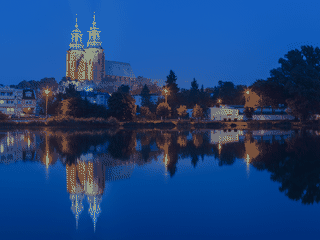

Gniezno
Eastern Europe and the Balkans · Poland
Did you know?
- The Museum of Beginnings of the Polish State explores early Polish history.
- The cathedral stands on Wzgórze Lecha, within walking distance of the market square.
- Romanesque bronze cathedral doors depict scenes from the life of Saint Adalbert.
See also
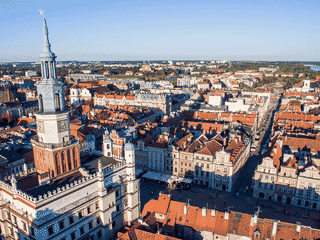

Poznań
Poland52.40°N 16.92°E
Overview
Gniezno's cathedral and market square sit within a compact historic center. Exploring on foot gives travelers an easy way to connect its religious landmarks and central streets.
Languages: Polish
Why go?
Gniezno is the legendary first capital of Poland, where the country's first rulers were crowned in the 10th-14th centuries. The city preserves Poland's most precious Romanesque monument—the 1170s bronze door of its cathedral depicting scenes from St. Adalbert's life—and serves as the spiritual seat of Polish Catholicism as the nation's first archbishopric. For backpackers, Gniezno offers a concentrated dose of early Polish history without the crowds of Kraków or Warsaw, plus easy access to the Piast Route and Greater Poland's lake district.
Adapted from Wikivoyage contributors · CC BY-SA 4.0
Getting there
Gniezno railway station is a regional hub on the Poznań–Warsaw main line. Trains to Poznań take about 50 minutes; major cities like Bydgoszcz and Toruń are reachable in 60-90 minutes by rail or road. The city sits roughly 50 km northeast of Poznań, making it a straightforward day trip or overnight from the larger city.
Adapted from Wikivoyage contributors · CC BY-SA 4.0
Get around
The historic center, including the cathedral on Wzgórze Lecha and the Rynek (market square), is compact and best explored on foot. Local buses serve areas beyond the center.
Adapted from Wikivoyage contributors · CC BY-SA 4.0
When to go
Late April brings Gniezno Days and the Long-Distance International Run of the United Europe. June hosts the Polish Piast Bike Rally, International Jazz Festival (Jazz Pod Piątką), and International Organ Festival with Sunday concerts in the cathedral. April 23 marks Saint Adalbert's Day and the city's nameday; May features the student festival Juwenalia.
Adapted from Wikivoyage contributors · CC BY-SA 4.0
Where to stay
Budget options include the Medical School Hostel (27 Mieszka I), The School Centre Hostel (16 Powstańców Wlkp.), and two youth hostels—one centrally at 11 Pocztowa, another 15 km away in Lednogóra. Mid-range options include Hotel City on Rynek Square, Hotel Lech, Hotel Orzeł, and Hotel Pietrak near the cathedral. Advance booking is recommended during festivals in April-June.
Adapted from Wikivoyage contributors · CC BY-SA 4.0
Food and drink
Restaurants line the Rynek Square and surrounding streets. Budget-friendly options include City Bar (15 Rynek), Stołówka CEG (5-7 Kostrzewskiego), and several pizzerias and milk bars. Upscale dining is available at Hotel Pietrak's restaurant (3 Chrobrego) and Ristorante Italiano (12 Tumska). Polish cuisine is well-represented at Karczma Wiejska in Czerniejewo and restaurant-palace establishments in the surrounding towns.
Adapted from Wikivoyage contributors · CC BY-SA 4.0
Things to do
The Cathedral of the Assumption and St. Adalbert (Wzgórze Lecha) is free to enter, with paid sections open M-Sa 09:00-17:00 May-Oct, 09:00-16:00 Nov-Apr; Sundays closed. Its Romanesque bronze door from c. 1170 is Poland's most precious Romanesque artwork. The Gniezno Archbishopric Museum (Kolegiaty 2, 15 zł/11 zł reduced) displays liturgical treasures including St. Adalbert's chalice and the Golden Gniezno Codex. The Museum of Beginnings of The Polish State (Kostrzewskiego 1, 20 zł/16 zł reduced, free Sundays) covers early Polish history with Romanesque art and ceramic tiles. Tours of the cathedral crypt and Bronze Door require a guide. The Archbishopric Archives preserve papal bulls from the early Middle Ages.
Adapted from Wikivoyage contributors · CC BY-SA 4.0
Day trips
The Piast Route connects Gniezno to nearby historic sites: Ostrów Lednicki, an island with a 10th-century medieval fortress on Lednica Lake, and Dziekanowice with its open-air museum of Greater Poland architecture. The area around Gniezno includes Czerniejewo (classicist palace), Żnin with Biskunin archaeological site, the narrow-gauge railway to "Wenecja," Trzemeszno with one of Poland's oldest churches, and Strzelno with a Romanesque rotunda. All are reachable within 60-90 minutes by road or rail.
Adapted from Wikivoyage contributors · CC BY-SA 4.0
Go next
Poznań (50 km west) offers Poland's second-largest city with its Renaissance Old Town and vibrant student culture. Bydgoszcz and Toruń are both within 90 minutes, offering Gothic architecture and the medieval city of Toruń. Within Greater Poland, the Piast Route day-trip circuit covers Ostrów Lednicki, Dziekanowice, and the narrow-gauge railway towns to the north.
Adapted from Wikivoyage contributors · CC BY-SA 4.0
Field guide adapted from Wikivoyage contributors · CC BY-SA 4.0. Text has been adapted and organized for this guide. About our sources.
Places to know
A few starting points from the guide. Check current hours and prices before you go.
- eat
City Bar
Adapted from Wikivoyage contributors
- eat
Europejska
Adapted from Wikivoyage contributors
- eat
Herbowa
Adapted from Wikivoyage contributors
- eat
Hubertus
Adapted from Wikivoyage contributors
- eat
Karczma Wiejska
Adapted from Wikivoyage contributors
- eat
Kleckowianka
Adapted from Wikivoyage contributors
- eat
Klub Muzyczny "Młyn"
Adapted from Wikivoyage contributors
- eat
Królewska
Adapted from Wikivoyage contributors
Before you go
Connectivity
Mobile coverage is standard Polish urban. WiFi available at hotels and some cafes; check with individual establishments.
Culture
As the seat of Poland's first archbishopric, Gniezno has strong Catholic heritage. Dress modestly when visiting the cathedral, especially during services.
Language
Polish is the local language. English is limited outside hotels and tourist offices; German is more commonly understood among older residents.
Money
Poland uses the złoty (PLN). ATMs are available in the city center. Credit cards are accepted at hotels and larger restaurants.
Safety
Gniezno is a small, generally safe city. Standard urban precautions apply; the area around the railway station warrants awareness at night.
Transport
Gniezno railway station connects to Poznań (50 min), Bydgoszcz, and Toruń. Local buses serve areas beyond the walkable historic center.
Weather
Best visited May-September for comfortable temperatures. Cathedral hours and outdoor activities are more accessible during these months.