
Omsk
Eastern Europe and the Balkans · Russia
Did you know?
- The local history museum displays an ebony Kalmyk throne.
- Dostoevsky spent his Siberian exile in this city.
- The Liberov-Center art museum occupies a historic wooden house.
See also
Overview
Omsk pairs a merchant-era centre with museums and an ornate drama theatre. Dostoevsky's exile gives the city an extra layer of literary history.
Languages: Russian
Why Go
Omsk is Russia's seventh largest city with over 1.5 million residents, serving as the capital of Omsk Oblast and a regional hub for Western Siberia and the Altai mountains. Founded in 1716 as a frontier fortress, the city flourished in the late 1800s following the Trans-Siberian Railway construction, acquiring its distinctive neoclassical architectural heritage around the 1910 World Fair. Visitors come for the attractive 19th-century merchant center centered on Lyubinsky prospekt, numerous museums, and cultural venues including the ornate Omsk Drama Theatre. Literature enthusiasts find special interest in Omsk as Dostoevsky's home during his exile from Saint Petersburg.
Adapted from Wikivoyage contributors · CC BY-SA 4.0
When to Go
Omsk experiences extreme continental climate with long, severe winters averaging -21°C in January and warm summers reaching 25°C in July-August. Precipitation peaks in summer months (55-65mm in June-July). The most comfortable visiting period is late spring through early autumn (May-September) when temperatures are mild and outdoor exploration is pleasant. Winter visits offer opportunities to experience Siberian ice hockey culture at Arena-Omsk, home to the Omsk Avangard team.
Adapted from Wikivoyage contributors · CC BY-SA 4.0
Getting In
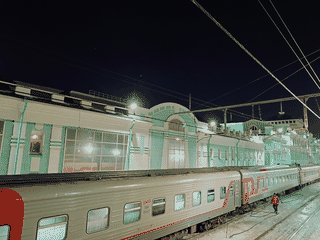
Omsk Tsentralny Airport (IATA: OMS) handles approximately 1 million passengers annually, located 7 km south of the city centre. Regular flights connect Omsk with Moscow, Saint Petersburg, Yekaterinburg, Novosibirsk, Astana, Bishkek, Istanbul, Simferopol. The city is a major hub on the Trans-Siberian Railway between Yekaterinburg (west) and Novosibirsk (east), with train connections to Tyumen, Irkutsk, and destinations across Russia. The railway station is centrally located on Lenin Street.
Adapted from Wikivoyage contributors · CC BY-SA 4.0
Getting Around
Omsk's historical center centers on Lyubinsky prospekt near the Om and Irtysh river confluence. The main attractions including museums, churches, and theaters line Lenin Street and are walkable within the central district. Public transport includes buses, trolleybuses, andmarshrutka (shared minivan) taxis. The city map coordinates are 54.966821, 73.314590 at zoom level 11.
Adapted from Wikivoyage contributors · CC BY-SA 4.0
Where to Stay
Accommodation options range from budget hostels near the train station to mid-range hotels in the city center. Millenium na Marksa (pr-kt Karla Marksa 84a) offers dorms and private rooms with kitchen, laundry, and WiFi facilities, located about 15 minutes from the center. The Ibis-Sibir Omsk (Lenina ul. 22) provides international chain comfort at competitive rates. For budget travelers, Turist Hotel Omsk (Josip Broz Tito ul. 2) offers good value despite potential noise. Hotel prices typically start from approximately 2,500 RUB for budget options.
Adapted from Wikivoyage contributors · CC BY-SA 4.0
Things to Do
The Omsk State Museum of Local History (ul. Lenina, 23) in the former West Siberian Governor's mansion features an ebony Kalmyk throne and nomadic costumes; Admiral Kolchak lived here in 1918-1919. The Museum Complex of Military Glory (ul. Taube, 7) covers WWII, Afghanistan, and Chechen conflict. Art lovers should visit the Omsk Regional M.A. Vrubel Museum of Fine Arts (ul. Lenina, 3) in the former bourse building, housing works including Rerikhs. The Liberov-Center State Regional Art Museum (Dumskaya ul. 3) occupies a historic wooden house. The 1843 St. Nicholas Cossack Cathedral (ul. Lenina, 27) is one of Siberia's oldest churches, while the Dormition Cathedral (ul. Internacional'naja, 12) built in the 1890s is one of the largest.
Adapted from Wikivoyage contributors · CC BY-SA 4.0
Nightlife
Lyubinsky prospekt houses some of the best nightlife in the city, alongside upscale shopping venues. Kolchak (Broz Tito str., 2/1) is an Irish pub notable as one of the only places in Siberia serving Guinness, with an excellent beer selection though limited food. Pivnaya Biblioteka (Partizanskaya St., 4) combines café and bar atmospheres with a library theme. For karaoke, Ogurtsy (Karla Marksa Av, 5А) offers entertainment. Zanzibar Nochnoy Klub (ul. Lukashevicha, 10В) provides nightclubbing options.
Adapted from Wikivoyage contributors · CC BY-SA 4.0
Day Trips
Omsk serves as a hub for regional exploration, with locals considering cities 700km away as 'nearby'. Tobolsk and Tomsk, Siberia's oldest cities, retain their picturesque pre-Soviet characters after being bypassed by main transportation arteries; reachable by overnight train. Tobolsk is also accessible by speed jet boat along the Irtysh River (10-12 hours). Seasonal boats operate to Khanty-Mansiysk and Salekhard within the Arctic Circle—a 2783 km journey taking six days. Barnaul (16 hours by train or 1.5 hours by air) is the gateway to Altai mountains and national parks. Kazakhstan connections include Petropavl (4 hours), Astana (12 hours) by train, and Pavlodar (8 hours) by bus.
Adapted from Wikivoyage contributors · CC BY-SA 4.0
Safety
Several neighborhoods should be avoided, particularly Neftyaniki (town of oilmen), Amurskiy posyolok (Amur settlement), Port Arthur, Staryi Kirovsk (Old Kirovsk), and the area around the Omsk tire plant. The central tourist areas around Lenin Street and Lyubinsky prospekt are generally safe for visitors during daylight hours.
Adapted from Wikivoyage contributors · CC BY-SA 4.0
Field guide adapted from Wikivoyage contributors · CC BY-SA 4.0. Text has been adapted and organized for this guide. About our sources.
Places to know
A few starting points from the guide. Check current hours and prices before you go.
- sleep
Avrora
3-star hotel.
Recorded price: From RUB
Adapted from Wikivoyage contributors
- sleep
Flagman Hotel
3-star hotel.
Adapted from Wikivoyage contributors
- sleep
Ibis-Sibir Omsk
3-star hotel.
Recorded price: From RUB
Adapted from Wikivoyage contributors
- sleep
Irtysh Hotel
3-star hotel.
Recorded price: RUB
Adapted from Wikivoyage contributors
- sleep
Mayak Hotel
RUB
Adapted from Wikivoyage contributors
- sleep
Millenium na Marksa
Hostel is on two (at least) floors, each floor has numerous bathrooms, a large kitchen, laundry facilities, WiFi and computer access. Offers dorms & privates. Mini hotel is located in the center of Omsk near the park of Friendship of Peoples near the stop "Sibzavod". Cheap hotel with economy rooms and suites.
Recorded price: From RUB
Adapted from Wikivoyage contributors
- sleep
Nika
A nice small hotel with a restaurant and a sauna. Popular and can be fully booked with ice hockey teams. You could try horse meat at the restaurant along with Stella Artois beer on draft.
Recorded price: Single: RUB
Adapted from Wikivoyage contributors
- sleep
Turist Hotel Omsk
Noisy, but good location and value.
Recorded price: From RUB
Adapted from Wikivoyage contributors
Before you go
Culture
Omsk was Admiral Kolchak's anti-Soviet capital in 1918-1919 and Dostoevsky's exile home. The city preserves 19th-century neoclassical architecture from its boom period.
Money
Currency is Russian Ruble (RUB). International hotel chains like Ibis accept cards, but smaller establishments and local restaurants may prefer cash.
Safety
Avoid Neftyaniki, Amurskiy posyolok, Port Arthur, Staryi Kirovsk, and the Omsk tire plant area. Central tourist zones are generally safe.
Transport
Omsk Tsentralny Airport (OMS) is 7 km south of center with flights to Moscow, Saint Petersburg, Yekaterinburg, Novosibirsk, and international destinations. The city is a major Trans-Siberian Railway hub.
Weather
Extreme continental climate with harsh winters (-21°C January average) and warm summers (25°C July average). Best visiting season is May-September.