
Nagasaki
East Asia · Japan
Did you know?
- Its signature champon noodles combine pork broth with vegetables and seafood.
- The Lantern Festival brings more than 20,000 lanterns during Lunar New Year.
- Daytime trams run every 10–15 minutes, with one-way trips costing ¥140.
See also
Overview
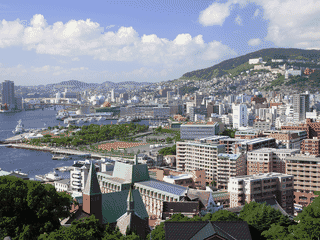
Nagasaki layers Dutch, Portuguese, and Chinese influence over a steep harbor city that turned its wartime tragedy into a major peace destination. Trams, Chinatown food, hillside views, and island excursions make it unusually varied for a Kyushu stay.
Languages: Japanese
Why Go
Nagasaki stands apart from Japan's major tourist circuits as a city where centuries of isolation policy couldn't prevent cultural fusion—Dutch traders, Portuguese missionaries, and Chinese merchants all left indelible marks. The city carries the weight of being one of two cities destroyed by atomic weapons, yet has transformed this tragedy into one of the world's most powerful peace memorials. Beyond its historical gravity, Nagasaki offers genuine regional cuisine (champon and castella), a compact old city accessible by historic streetcars, and access to Gunkanjima, the abandoned battleship island that inspired James Bond films.
Adapted from Wikivoyage contributors · CC BY-SA 4.0
Get In
Nagasaki Airport is served by JAL and ANA with nonstop flights from Tokyo Haneda Airport. Nagasaki Station serves as the main rail hub on the JR Kyushu network, with the Kamome train line connecting to nearby Sasebo and Huis Ten Bosch. Long-distance buses arrive at Nagasaki Station as well.
Adapted from Wikivoyage contributors · CC BY-SA 4.0
Get Around
Trams (路面電車 romen densha or チンチン電車 "chin-chin densha") connect most of Nagasaki, running every 10-15 minutes during the day. The red line (3) and blue line (1) are most frequently used—they share tracks from the northern end to Nagasaki Station, then split. Blue line continues to Dejima and the downtown shopping arcade. One-way trips cost ¥140; transfer tickets (乗り継ぎ券 noritsugi ken) allow continuation on a second streetcar if acquired at Tsuki Machi stop. Daily passes cost ¥500 and are available at the Tourist Information Center at Nagasaki Station or major hotels. Buses cover areas not served by trams. Trams stop around 23:00, and Shianbashi nightlife can leave you stranded until 06:00 for the first tram—it takes about an hour to walk to Sumiyoshi.
Adapted from Wikivoyage contributors · CC BY-SA 4.0
When To Go
Nagasaki's Lantern Festival runs mid-January to mid-February during Lunar New Year, when over 20,000 lanterns illuminate Chinatown and river areas. O-Kunchi (October 7-9) is the city's biggest festival, featuring giant choreographed floats and street vendors. O-Bon in August brings unique Nagasaki-style ancestor worship with heavy alcohol and fireworks at the harbor. Summer is hot and humid; spring and autumn offer milder temperatures for sightseeing.
Adapted from Wikivoyage contributors · CC BY-SA 4.0
Where To Stay
Budget travelers should head to Chinatown-area guesthouses: Casa Noda (dorm ¥2400, private ¥6000, cash only) and Casa Blanca Guesthouse (¥2600, cash only) offer dorm beds near major attractions. Nagasaki Kagamiya provides dorms (¥2300) or Japanese-style privates (from ¥2800/person) near Hotarujaya tram stop. For nightlife proximity in Shianbashi, Richmond Hotel (double ~¥7000) places you steps from bars with excellent English-speaking staff. JR Kyushu Hotel Nagasaki (from ¥7,600) sits directly in the station complex for maximum transit convenience.
Adapted from Wikivoyage contributors · CC BY-SA 4.0
Food And Drink
Nagasaki's signature dish is champon (ちゃんぽん)—thick noodles in pork-based broth loaded with vegetables, bacon, shrimp, squid, and scallops. Saraudon (皿うどん) serves the same ingredients over crispy fried noodles on a plate. Chinatown (blue line to Tsuki-machi stop) concentrates the best champon restaurants alongside street food: kakuni-manju (braised pork in steamed bun), ebichirman (shrimp in chili sauce in steamed bun), and marakao (steamed pound cake in chocolate or chestnut). Castella, the Portuguese-introduced sponge cake, is sampled free from vendors on the Dutch Slope (オランダ坂). The original Turkish Rice (ungkook raisu)—pork cutlet, curry rice, and spaghetti—has been served at (ツル茶ん) since 1925 for ¥850, open 09:00-22:00. Nagasaki also claims to be the birthplace of tempura, introduced by Portuguese missionaries in the 16th century.
Adapted from Wikivoyage contributors · CC BY-SA 4.0
Things To Do
The Atomic Bomb Museum (¥200, 08:30-17:30) provides a powerful anti-nuclear argument through well-designed exhibits—buy ice cream afterward. Glover Garden (¥620, 08:00-18:00) displays relocated European-style homes from the Meiji era with panoramic harbor views. Inasayama offers the "10 Million Dollar View"—ranked among Japan's top three night cityscapes—accessible by ropeway (¥1250 round trip, 09:00-20:00), bus (¥150 from Nagasaki Station), or taxi (~¥2200 one-way). Gunkanjima (Battleship Island) requires a boat tour (¥5000 adults weekdays, ¥5500 weekends); landing fees are adult/youth ¥310, child ¥120. Dejima (¥520, 08:00-21:00) recreates Japan's sole Western trade port from 200 years of isolation. Shinchi Chinatown is Japan's oldest, dating to the 15th century. The Nagasaki Penguin Aquarium (¥500) sits 30 minutes by bus from the station near a sandy beach.
Adapted from Wikivoyage contributors · CC BY-SA 4.0
Safety
Nagasaki is generally a safe city, though standard urban precautions apply in Shianbashi's nightlife district at night. The main safety concern is late-night tram service ending around 23:00—if you stay out in Shianbashi, you may need to wait until 06:00 for the first tram or walk the hour to Sumiyoshi. Gunkanjima tours are frequently cancelled for bad weather due to precarious dock conditions. The Nagasaki Museum for Human Rights and Peace documents Japanese war crimes and foreign atomic bomb victims, though exhibits have limited English explanation.
Adapted from Wikivoyage contributors · CC BY-SA 4.0
Connectivity
Japan uses Type A/B power plugs (two flat parallel pins, or two angled flat pins plus grounding). Standard voltage is 100V. WiFi is available in most hotels and some cafes; international roaming or local SIM cards are recommended for consistent connectivity. A multi-lingual call center (+81-95-825-5175, 08:00-20:00 365 days) answers tourism questions in English and 16 other languages.
Adapted from Wikivoyage contributors · CC BY-SA 4.0
Budget
Budget travelers can get by on ¥3,500-4,500/day covering dorm accommodation (¥2,300-2,600), streetcar rides (¥140 one-way, or ¥500 daily pass), and budget meals (¥500-800 per meal for ramen, convenience store food, or Chinatown street snacks). Major attractions add up: Atomic Bomb Museum ¥200, Glover Garden ¥620, Dejima ¥520, Gunkanjima cruise ¥5,000+. Mid-range accommodation runs ¥6,500-7,600 for doubles.
Adapted from Wikivoyage contributors · CC BY-SA 4.0
Day Trips
Gunkanjima (Battleship Island) is a 45-minute guided boat tour to the abandoned coal mining island 15km offshore, famous from the James Bond film Skyfall. Iojima beach is reachable by 10-15 minute boat ride from Nagasaki harbor (¥1500), plus ¥500 for hot springs access. Nagasaki Bio Park, north of the city, is perhaps the world's largest petting zoo with capybara, flamingos, and wallabies—take the Ogushi bus line from Nagasaki Station to Kamedake. Sasebo's Huis Ten Bosch is a Dutch-themed amusement park accessible via Kamome train line.
Adapted from Wikivoyage contributors · CC BY-SA 4.0
Go Next
Nagasaki Station connects north via JR Nagasaki line to Saga and beyond. The Kamome train line runs to Sasebo and Huis Ten Bosch. Southbound trains end at Nagasaki. By bus, destinations include Unzen, Shimabara, and the Isahaya area. Ferries connect to outlying islands including Ikeshima, an abandoned coal mining island similar to Gunkanjima but less visited.
Adapted from Wikivoyage contributors · CC BY-SA 4.0
Field guide adapted from Wikivoyage contributors · CC BY-SA 4.0. Text has been adapted and organized for this guide. About our sources.
Places to know
A few starting points from the guide. Check current hours and prices before you go.
- sleep
ANA Crowne Plaza Nagasaki Gloverhill
Four-star hotel close to the international cruise ship terminal, Glover Hill and most sights in the old part of Nagasaki. Its convention center is popular, too. Most guests are business traveler or package tourists. Breakfast is good but expect crowds in the morning.
Adapted from Wikivoyage contributors
- sleep
Casa Blanca Guesthouse
Nice guest house in a nice place of the city. Near China town. Cash only. English is spoken.
Recorded price: ¥2600
Adapted from Wikivoyage contributors
- sleep
Casa Noda
The owner is nice and gives very good tips about the local restaurants and temple area. Good English is spoken. Use the map on their website to find it.
Recorded price: Dormitory ¥2400, mixed or female-only. Private twin rooms ~¥6000. Breakfast included, cash only
Adapted from Wikivoyage contributors
- sleep
JR Kyushu Hotel Nagasaki
Good value business hotel owned by JR - incredibly convenient as it's in the station complex.
Recorded price: From ¥7,600
Adapted from Wikivoyage contributors
- sleep
Minato Sauna
A sauna/sento (bathhouse) and capsule hotel located two blocks east of Nagasaki ferry terminal. Look for the jolly sailor logo on the and note that despite the clearly arrowed signage, the entrance is actually in the alley to the left. Sauna-only prices vary by time, but the full overnight stay costs ¥3675. Although mid-range in capsule hotel pricing, the facilities are top-notch with completely smoke free sleeping quarters, sauna entry and re-entry included, free phone charging facilities and none of the common surprise towel, yukata or otherwise dodgy surcharges. An affordable restaurant and bar are on site as is a coin laundry so you can even wash the pants you are wearing. Men only.
Adapted from Wikivoyage contributors
- sleep
Nagasaki Kagamiya
Air conditioning, wifi, laundry available, shared fridge but no kitchen. Photos on the web site provide detail on how to find the location.
Recorded price: Mixed dormitory ¥2300 (Western or Japanese style), Japanese-style private starting at ¥2800 per person. Cash only
Adapted from Wikivoyage contributors
- sleep
Richmond Hotel
An upmarket business hotel with very modern finishings, in the heart of Shianbashi—if you want to exploit the nightlife to its fullest and not worry about tram service ending, this is your place. Excellent English-speaking staff can assist with tourism inquiries.
Recorded price: Double ~¥7000
Adapted from Wikivoyage contributors
- sleep
Victoria Inn Nagasaki
Very centrally located, a few minutes' walk from Shianbashi, the shopping arcades, Shinchi Chinatown, and the central Tsuki-Machi tram stop. Spacious rooms, including huge luxury Victorian-styled rooms available on upper floors. Elegant old-world styled bar that is worth a visit even if you don't stay at the hotel, open late and happy hour specials. Organic restaurant that serves guest breakfasts.
Recorded price: Double ¥6500-7000
Adapted from Wikivoyage contributors
Before you go
Connectivity
Type A/B power plugs, 100V. WiFi in hotels; consider local SIM or international roaming for consistent mobile data.
Food
Nagasaki chanpon (noodles in pork broth with seafood) and castella (Portuguese sponge cake) are local specialties. Chinatown has the best restaurants and street food.
Language
Japanese is the primary language. English signage is limited but present at major attractions. Multi-lingual tourism hotline available.
Money
Japan uses yen (¥). Credit cards accepted at hotels and larger stores, but many guesthouses, smaller restaurants, and attractions are cash-only.
Safety
Safe city overall; main issue is late-night tram service ending around 23:00 in Shianbashi nightlife district.
Transport
Streetcars (¥140 one-way, ¥500 daily pass) are the main local transport; trams stop around 23:00. Buses cover areas trams don't reach.