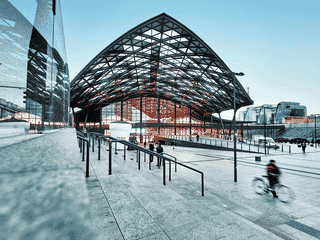

Łódź
Eastern Europe and the Balkans · Poland
Did you know?
- Museum collections span film, textiles, art and Jewish history.
- The Dętka museum leads visitors into a former underground water reservoir.
- Textile factories and magnates shaped the city during the 19th-century industrial boom.
See also
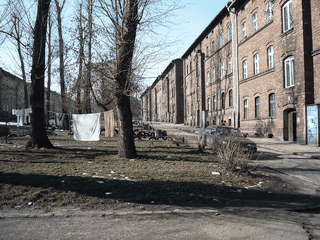

Częstochowa
Poland50.80°N 19.12°E · 317 m
.jpg)
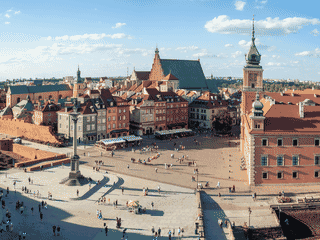
Warsaw
Poland52.10°N 21.00°E · 118 m
Overview
Łódź grew through a textile boom that shaped its factories, workers' neighborhoods and magnates' residences. That industrial past gives the city a distinctive historical character.
Languages: Polish
Why go?
Łódź is Poland's third largest city, created during the 19th-century textile boom to house factories, workers, and magnates. Today, it offers one of Europe's largest collections of preserved industrial architecture—massive repurposed factories now house shopping centers, lofts, and museums. The city has excellent museums rivaling Warsaw's best, vibrant nightlife centered on Piotrkowska Street, and serves as a practical base for day trips to medieval towns and the capital. Foreign investment in IT industries has transformed the economy since the Soviet era, giving visitors a modern, forward-looking city with deep historical roots.
Adapted from Wikivoyage contributors · CC BY-SA 4.0
Getting in
Łódź Władysław Reymont Airport (LCJ) lies approximately 6 km from the city center and is one of Poland's smallest airports. As of June 2023, Ryanair operates flights to Dublin, London Stansted and Luton, Milan Bergamo, Alicante, and Brussels Charleroi, plus seasonal charter flights to Mediterranean holiday destinations. Łódź is well-connected by train from Warsaw (Łódź Kaliska or Łódź Widzew stations), and the A2 motorway links Warsaw (130 km east) and Poznań (200 km west).
Adapted from Wikivoyage contributors · CC BY-SA 4.0
Getting around
Łódź is a fairly compact city; most attractions are in the center, though some lie on the outskirts. Public transport includes trams and buses connecting all major areas. Piotrkowska Street—the longest commercial street in Europe—is pedestrian-friendly with about 5 km of car-free strolling from Liberty Square to Independence Square. The Łódź Hills Landscape Park is reachable by bus line 88 from the Academy of Art (about 30 minutes).
Adapted from Wikivoyage contributors · CC BY-SA 4.0
When to go
Summer (June-August) brings warm weather (19-25°C) and numerous outdoor festivals. The city hosts the Łódź Design Festival in May, the International Festival of Photography (Fotofestiwal) in May-June, and the Summer Academy of Jazz in July-August. September features the Łódź of Four Cultures Festival promoting tolerance between the four nations that built the city. October's Light Move Festival transforms public spaces with spectacular light and video installations. Winter is colder (-4°C to 2°C) but offers fewer tourists and lower accommodation prices.
Adapted from Wikivoyage contributors · CC BY-SA 4.0
Where to stay
Łódź lacks cheap hostel accommodation but offers generally low mid-range hotel prices. Budget travelers can try the Hostelling International Youth Hostel near Piotrkowska (30 zł per person) or Music Hostel on Piotrkowska 60 (45-60 zł) with free breakfast. Boutique Hotel's locations near Manufaktura offer doubles from 144-188 zł. The city center is recommended for first-time visitors to minimize transport time. Sleep price range: under 100 zł (budget), 100-300 zł (mid-range), over 300 zł (upscale).
Adapted from Wikivoyage contributors · CC BY-SA 4.0
Food and drink
Łódź's culinary scene reflects international influences—finding explicitly Polish cuisine in cheap eateries is difficult. For budget meals, try kebab or Yem joints, or get a sandwich for 6-8 zł. Look for 'Pierogarnia' establishments serving Polish dumplings at competitive prices. Manekin (ul. 6 Sierpnia 1) serves pancakes in all varieties for 7-15 zł. Green Way (Piotrkowska 80) offers vegetarian fast food with soup from 3 zł and a second plate for 6-9 zł. Food delivery apps include Pyszne.pl, Pizzaportal.pl, Glovo, and UberEats. Piotrkowska Street and Kościuszki Street concentrate dozens of pubs and restaurants, while Manufaktura hosts festivals but closes earlier.
Adapted from Wikivoyage contributors · CC BY-SA 4.0
Things to do
Łódź offers museums spanning art, film, textiles, and Jewish history. The ms1 (Więckowskiego 36) is one of Europe's first modern art museums with Poland's best 20th-century collection (adults 7 zł, free Fridays). The Film Museum (pl. Zwycięstwa 1) costs 28 zł. The Museum of Textiles in the White Factory (Piotrkowska 282) shows 10 zł, with Saturdays free. The Jewish Cemetery on Zmienna Street is Europe's largest (15 zł, free first Sunday monthly). The Łódź Hills Landscape Park offers nature walks 30 minutes by bus. Summer brings free entry to Lunapark theme park. The zoo (Konstantynowska 8/10) charges 15-20 zł for adults.
Adapted from Wikivoyage contributors · CC BY-SA 4.0
Safety
Despite a rough reputation stemming from 1990s-2000s events, Łódź is now safe with relatively low crime (39 crimes per 1000 citizens in 2008, lower than any other large Polish city). Violent crime is rare. Watch for pickpockets who create artificial crowds on buses and trams—keep wallets in front pockets. Avoid city parks after dark due to reported muggings. Locals advise avoiding Włókiennicza Street (and nearby parts of Wschodnia and Kilińskiego), Abramowskiego Street, Solna Street, and Limanowskiego Street. Football hooliganism is significant; avoid displaying team emblems, especially during ŁKS vs Widzew derbies. Pedestrians should be cautious at crossings as drivers don't always respect right-of-way.
Adapted from Wikivoyage contributors · CC BY-SA 4.0
Connectivity
Łódź has generally good mobile coverage with Polish carriers (Plus, Orange, T-Mobile, Play). WiFi is available at most hostels, cafes, and restaurants—Green Way offers free wireless access. Coffeeheaven and Mała Litera bookshop-cafe provide WiFi for customers. Power outlets use European Type C/F (two round pins, 230V). The Polish language dominates, but English levels are high among young people; older generations may speak Russian or German.
Adapted from Wikivoyage contributors · CC BY-SA 4.0
Budget
Łódź offers good value for Poland. Budget travelers can eat for 15-30 zł/day eating street food, kebabs, and pierogi. Sandwiches cost 6-8 zł, restaurant meals 15-30 zł. Museum admissions range 4-16 zł (many have free Friday entry). Public transport is affordable. A double room in a hostel or budget hotel costs 45-120 zł, mid-range hotels 100-300 zł. Daily budget of 120-200 zł covers accommodation, food, transport, and one museum or activity. ATMs are widely available.
Adapted from Wikivoyage contributors · CC BY-SA 4.0
Day trips
Several destinations are reachable from Łódź. Łęczyca (40 km north, 1 hour by train from Łódź Kaliska) has a medieval royal castle and knight tournaments. Łowicz (60 km northwest, 1h15m by train) is famous for colorful regional costumes, folk art, archbishop's residence, churches, and monasteries. Nieborów and Arkadia (reachable via Łowicz) offer baroque palace and English-style romantic park with artificial ruins. Spała village has a landscape park and spa resorts. For larger cities, Warsaw is 130 km east via A2 (fastest by train), Poznań is 200 km west via A2, and Toruń (Copernicus's birthplace) is 160 km north via A1.
Adapted from Wikivoyage contributors · CC BY-SA 4.0
Go next
Łódź sits at crossroads of Poland's motorway system. Warsaw (130 km east) offers Poland's capital with world-class museums and nightlife—take the train from Łódź Kaliska or Łódź Widzew, or drive via A2. Poznań (200 km west via A2) has Poland's oldest cathedral. Toruń (160 km north via A1) is one of Poland's oldest towns and Copernicus's birthplace. The medieval town of Łęczyca is 40 km north with its royal castle. The A1 highway continues north toward the Baltic coast.
Adapted from Wikivoyage contributors · CC BY-SA 4.0
Field guide adapted from Wikivoyage contributors · CC BY-SA 4.0. Text has been adapted and organized for this guide. About our sources.
Places to know
A few starting points from the guide. Check current hours and prices before you go.
- do
AZS Clubs
Every major university has its own Academic Sports Society Club. They offer various activities (sekcje or sections) ranging from chess to sailing for low prices.
Adapted from Wikivoyage contributors
- do
Arena Łódź
Large multi-purpose indoor arena hosting both concerts and sports events like basketball, volleyball or ice hockey matches.
Adapted from Wikivoyage contributors
- do
Artur Rubinstein's Łódz Philharmonic
Second oldest philharmonic in Poland. If you are a fan of classical music, this is a place to go. Behind the philharmonic is Kino Bałtyk.
Adapted from Wikivoyage contributors
- buy
Bałuty Market
Big open air market, every Saturday you can buy everything here from vegetables, to clothes to live pets. Not romantic, but an experience.
Adapted from Wikivoyage contributors
- drink
Bierhalle
A German-style brewery. They close quite early, but the beer is good.
Adapted from Wikivoyage contributors
- do
Bodo
The small independent cinema theater with a program that will delight true cinephiles. There is also a second hall - the exprerimental one that seats only 5 spectators.
Recorded price: 15-18 PLN
Adapted from Wikivoyage contributors
- do
Cinema City
Comfortable, big theater with 14 cinema halls and 1 big IMAX hall offering projections of 3D movies. Movie selection contains the latest Hollywood hits with Polish subtitles.
Adapted from Wikivoyage contributors
- buy
Dolna-Ceglana Market
The biggest open-air vegetable market for individual people. Very often by mistake named as Rynek Bałucki - but they are two different places.
Adapted from Wikivoyage contributors
Before you go
Food
International cuisine dominates cheap eateries. Try pierogarnia for Polish dumplings, kebab shops for cheap meals, or Manekin for budget pancakes. Polish restaurants are more expensive.
Language
Polish is official language. English is common among young people. Older residents may speak Russian or German. Learning basic phrases like "dziękuję" (thank you) and "proszę" (please) is appreciated.
Money
Currency is Polish Złoty (PLN). ATMs widely available. Cards accepted at hotels, restaurants, and malls but carry cash for markets and smaller establishments.
Safety
Generally safe city with low crime rates. Avoid parks after dark, watch for pickpockets on public transport, and avoid displaying football emblems during derbies.
Transport
Łódź has efficient tram and bus network. Piotrkowska Street is pedestrian-only. Taxis are affordable. Train stations include Łódź Kaliska, Łódź Widzew, and Łódź Fabryczna.
Visa
Poland is in the Schengen Area. EU/EEA citizens need only ID. Many nationalities can visit visa-free for up to 90 days.
Weather
Summers (June-August) are warm (19-25°C) with festivals. Winters are cold (-4°C to 2°C) with fewer tourists. Spring and autumn offer mild temperatures and fewer crowds.