.jpg)
Kraków
Eastern Europe and the Balkans · Poland
Did you know?
- The Royal Way links St Florian's Gate, the market square and Wawel Castle.
- Leonardo da Vinci's Lady with an Ermine hangs in the Czartoryski Museum.
- Street vendors sell obwarzanki, ring-shaped bread associated with the city.
See also
Oświęcim
Poland50.05°N 19.23°E · 230 m
Overview
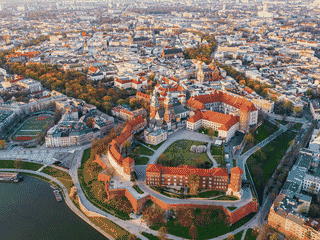
Kraków brings together a medieval Old Town, Wawel Castle and the riverside setting of the Vistula. Kazimierz and Nowa Huta add contrasting chapters of Jewish and socialist-era history.
Languages: Polish
Why Go
Kraków was Poland's medieval capital and retains one of Europe's finest preserved Old Towns, with the grand Rynek Główny market square, St Mary's Basilica, and Wawel Castle crowning a crag above the Vistula River. Beyond the historic core, the atmospheric Jewish quarter of Kazimierz and the stark Soviet-era district of Nowa Huta offer contrasting layers of history. Budget airlines have made this increasingly accessible, and it's Poland's undisputed top tourist draw, offering cobblestone charm without Warsaw's industrial grit.
Adapted from Wikivoyage contributors · CC BY-SA 4.0
Getting In
Kraków Airport (KRK) in Balice sits 12 km west of center, serving Ryanair, Easyjet, Lufthansa, Wizz Air and Norwegian with routes across Europe. The airport has fog issues in winter causing cancellations. Kraków Główny railway station lies just north of Old Town, with PKP Intercity services to Warsaw (2h40m), Katowice, Gdańsk and international destinations. The classical station facade is now an empty shell, with the actual station hidden underground behind Galeria Krakowska mall. Bus station adjoins the railway station.
Adapted from Wikivoyage contributors · CC BY-SA 4.0
Getting Around
Kraków is compact and most sights are walkable, with occasional tram rides. The tram network covers the city comprehensively, with single rides around 3-4 zł. Bike rental is popular in summer, with options like Bike Rental at ul. św. Anny 4 (7 zł/hour, 40 zł/24hr) offering tandems. Four bike rental shops listed operate daily from 09:00-18:00/20:00 in warm months.
Adapted from Wikivoyage contributors · CC BY-SA 4.0
When To Go
Kraków has four distinct seasons: hot humid summers with highs of 25°C and long evenings at riverside cafes, and freezing winters with snow blanketing the city (lows of -3°C to -4°C). Spring (April-May) and autumn (September-October) offer mild temperatures ideal for sightseeing. The city has a robust festival calendar including Jewish Culture Festival (late June), Krakow Film Festival (late May), Unsound experimental music (October), and Sacrum Profanum (November). Note: Kraków suffers significant air pollution from cars and coal stoves, particularly affecting those with respiratory issues in winter.
Adapted from Wikivoyage contributors · CC BY-SA 4.0
Where To Stay
Old Town and the ring road offer the most convenient base for first-time visitors, with easy walking distance to major sights. Kazimierz (Jewish Quarter) has more affordable hostels, trendy bars and authentic atmosphere, making it popular with backpackers. Stare Miasto (Old Town proper) commands premium prices. Avoid Nowa Huta district for accommodation—many hostels there are former worker shelters distant from the center. As tourist numbers increase, accommodation prices are rising across the board.
Adapted from Wikivoyage contributors · CC BY-SA 4.0
Food And Drink
Kraków's cuisine bears Austro-Hungarian and Central European influences, with obwarzanki (ring-shaped bread) sold by street vendors a quintessential snack. The Old Town is tourist-oriented with restaurants lining every alley; Kazimierz offers better value with cafes around Plac Nowy. The Cloth Hall (Sukiennice) ground floor is a bazaar for amber, sheepskin and craft souvenirs. Bar and pub density is remarkable—over 300 establishments in Old Town alone, making Kraków a nightlife capital.
Adapted from Wikivoyage contributors · CC BY-SA 4.0
Things To Do
Walk the Royal Way from St Florian's Gate down Floriańska, across the Main Market Square, then down Grodzka to Wawel Castle and Cathedral. Listen for the Hejnał Mariacki, the five-note trumpet played hourly from St Mary Church tower. Tour the Czartoryski Museum to see Leonardo da Vinci's Lady with an Ermine. Explore Schindler's Factory in Podgórze district for WWII history. Take a Sunday morning flea market crawl at Plac Nowy or Hala Targowa. River cruises sail to Tyniec Abbey from the wharf below Wawel. Free Walking Tours operated by Walkative Tour are highly recommended.
Adapted from Wikivoyage contributors · CC BY-SA 4.0
Safety
Kraków is generally very safe with strong police presence. Violent behavior is rare and usually alcohol-related—avoid late-night confrontations near pubs and clubs. Pickpockets operate in crowded areas, at stations, and on airport transport. Don't leave valuables visible in cars. The Municipal Guard (Straż Miejska) and Police (Policja) are generally helpful and speak basic English. Standard urban precautions apply.
Adapted from Wikivoyage contributors · CC BY-SA 4.0
Connectivity
Poland uses Type C/F electrical outlets (230V/50Hz). SIM cards from major carriers are readily available at convenience stores and phone shops. WiFi is widespread in hostels, cafes, restaurants and public spaces. Airport currency exchange (ICE) offers poor rates—15-20% either side of bank rate, so compare options in the city.
Adapted from Wikivoyage contributors · CC BY-SA 4.0
Budget
Kraków is one of Europe's more affordable capitals. Budget accommodation starts around 50-100 zł for a hostel dorm, while budget hotels run 150-300 zł. Street food like obwarzanki costs 3-5 zł, with restaurant meals from 20-50 zł. Tram rides are 3-4 zł, while day passes offer better value. Museum entry typically runs 10-25 zł. A daily backpacker budget of 150-250 zł covers accommodation, food and transport comfortably.
Adapted from Wikivoyage contributors · CC BY-SA 4.0
Day Trips
Auschwitz-Birkenau is a powerful day trip easily done independently or via organized tours. The Wieliczka Salt Mine (UNESCO site) is another major draw, reachable by train or bus. Boats cruise down the Vistula to Tyniec Abbey and Bielany Priory in summer. The Polish Aviation Museum is 5 km northeast in Nowa Huta. Those with more time can visit the Ojcowski National Park or the Tatra Mountains for hiking.
Adapted from Wikivoyage contributors · CC BY-SA 4.0
Go Next
Warsaw is 2h40m by train. The Tatra Mountains (Zakopane) offer hiking and skiing, about 2-3 hours south. Gdańsk on the Baltic coast is 4-5 hours north. Czech Republic (Prague) is an overnight train or bus away. Vienna is 6 hours south. Wrocław makes a logical circuit at 3-4 hours west.
Adapted from Wikivoyage contributors · CC BY-SA 4.0
Field guide adapted from Wikivoyage contributors · CC BY-SA 4.0. Text has been adapted and organized for this guide. About our sources.
Places to know
A few starting points from the guide. Check current hours and prices before you go.
- see
Czartoryski Museum (Princes Czartoryski Museum)
Houses Leonardo da Vinci's authentic Lady with an Ermine portrait, inside the Old Town walls.
Adapted from Wikivoyage contributors
- see
Kazimierz Jewish Quarter
Atmospheric Jewish quarter centered on Szeroka street, with Remuh synagogue and old cemetery.
Adapted from Wikivoyage contributors
- see
Main Market Square (Rynek Główny)
Grand medieval market square with St Mary's Basilica and the Cloth Hall, surrounded by historic burgher houses.
Adapted from Wikivoyage contributors
- see
National Museum
Main branch at foot of Aleja 3 Maja plus multiple branches including Czapski, Matejko House, and Eagle Pharmacy.
Adapted from Wikivoyage contributors
- see
Nowa Huta
Stark communist-era district built for steelworkers, with massive buildings surrounding green parks and a monument to central planning.
Adapted from Wikivoyage contributors
- see
Schindler's Factory (Oscar Schindler's Enamel Factory)
Museum documenting Kraków under Nazi German occupation in the original factory building.
Adapted from Wikivoyage contributors
- see
Wawel Castle
Medieval citadel on a crag housing the Royal Castle museum galleries and Wawel Cathedral.
Adapted from Wikivoyage contributors
- do
Bajit Chadasz
Jewish culture festival, organised by Jewish Cultural Centre in Kazimierz with concerts, exhibitions and lectures.
Adapted from Wikivoyage contributors
Before you go
Culture
Kraków has over 300 bars and pubs in Old Town alone. Jewish Culture Festival in June/July is world-renowned. Live music scene includes Unsound (October) and Sacrum Profanum (November).
Language
Polish is the official language. English is spoken by young people and in tourist areas. German is understood by some older residents. Basic Polish phrases are appreciated.
Money
Poland uses the złoty (PLN). ATMs are everywhere; credit cards accepted at most hotels and restaurants but carry cash for markets and small shops.
Safety
Generally very safe city with strong police presence. Violent crime is rare and alcohol-related. Pickpockets operate at transport hubs and crowds.
Transport
Kraków Główny station connects to Warsaw (2h40m PKP), Katowice, Gdańsk and international destinations. Local trams cover the city; single rides around 3-4 zł.
Weather
Summers reach 25°C with long evenings ideal for riverside drinking. Winters are freezing (-3°C to -4°C) with snow and significant air pollution from coal heating.