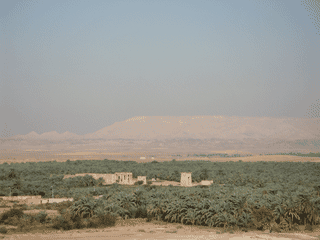

Kharga Oasis
Africa · Egypt
Did you know?
- El Bagawat contains 263 Coptic funeral chapels with fourth- to seventh-century frescoes.
- Most restaurants open around 19:00, with one all-day option in town.
- The Temple of Hibis dates to the Saite–Persian period, 2 km north of town.
See also

Luxor
Egypt25.68°N 32.65°E · 89 m

Aswan
Egypt24.09°N 32.90°E · 99 m
Overview
Kharga is a remote Western Desert oasis where Pharaonic, Roman, Christian, and Byzantine remains sit among stark desert landscapes. It suits independent travelers willing to arrange buses, guides, and off-road transport.
Languages: Arabic
Why go
Kharga is the largest of Egypt's five Western Desert oases, stretching 160 km long and 20-80 km wide. The main draw is the extraordinary concentration of antiquities—Pharaonic temples, Roman Christian settlements, Byzantine monasteries, and a string of Roman forts built to control the Darb el-Arbayin, the 'Forty Days Road' that once brought gold and ivory from Africa into Egypt. Unlike the crowded Nile Valley sites, Kharga offers an adventurous, off-the-beaten-path experience for those interested in ancient history and desert landscapes.
Adapted from Wikivoyage contributors · CC BY-SA 4.0
Getting in
Kharga has an airport but no commercial flights operate. Trains no longer reach the oasis—the narrow-gauge railway was replaced in 1989 by a standard-gauge track to Safaga on the Red Sea coast, but the phosphate deposits were never mined and the line was abandoned. The primary access is by bus from Asyut on the Nile Valley, or by private vehicle. A direct highway also connects Baris (south of Kharga) to Luxor. There are no trains, and hitchhiking or organized transport is necessary for reaching this remote destination.
Adapted from Wikivoyage contributors · CC BY-SA 4.0
Getting around
Kharga town and Baris are connected by a main road, but visiting archaeological sites in the desert requires private transport, an off-road vehicle, and often an official guide. Within Kharga town itself, everything is walkable. Taxis may be available for short trips, but for reaching remote Roman forts and temples, you will need to arrange a guide and 4x4 vehicle—these cannot be explored independently.
Adapted from Wikivoyage contributors · CC BY-SA 4.0
When to go
The climate is hot desert, with summer temperatures exceeding 40°C and winter temperatures around 10°C. There is zero rainfall year-round. The best time to visit is between October and April when temperatures are moderate. Summer visits (May-September) are extremely hot and not recommended for sightseeing. Note that all water in the oasis is 'fossil water' extracted from a non-renewable aquifer, so conservation is important.
Adapted from Wikivoyage contributors · CC BY-SA 4.0
Where to stay
Kharga has limited accommodation for its size as the biggest city in the New Valley. Budget options like Al Dar Al Bayda Hotel and El Radwan Hotel offer very simple rooms with AC. The mid-range El Safwa Hotel occupies a tiny 'skyscraper' with six rooms (one single, two doubles, three triples). Qasr El Bagawat Hotel near the necropolis is an ecolodge with six double bungalows and two suites—no WiFi, TV, or AC. The Solymar Pioneers is a four-star hotel with 102 rooms, pool, and restaurant, though reportedly offering poor value. Cheaper places are very barebones and should only be considered if you really must save money.
Adapted from Wikivoyage contributors · CC BY-SA 4.0
Food and drink
Kharga has a cluster of simple local restaurants in the town center, all with similar Egyptian fare. They will be delighted to see a Westerner, especially anyone with Arabic beyond 'salaam' and with ready cash. Restaurants mostly open only for dinner around 19:00. Wimby el-Bassatin is the only restaurant open throughout the day (08:00-01:00), serving chicken, liver, lasagne, soups, rice, vegetables, salads, kofta, and kebab. El-Baraka offers Egyptian cuisine and is open daily including lunch. Al-Geheiny near Midan el-Bassatin provides good value for kebab and kofta. Mint tea is always available any time of day. Hotel Sol Y Mar Pioneers also serves alcohol. There is nothing along the desert roads beyond the towns, so eat before venturing out.
Adapted from Wikivoyage contributors · CC BY-SA 4.0
Things to do
The Temple of Hibis, 2 km north of Kharga town, is a large well-preserved temple from the Saite-Persian period (664-404 BCE) dedicated to two versions of Amun. Admission is LE80 for adults, or LE120 for a combi-ticket with El Bagawat (November 2019 prices). The adjacent Necropolis of El Bagawat is one of Egypt's oldest Christian cemeteries with 263 Coptic funeral chapels and 4th-7th century frescoes. The Roman fortress of Umm al Dabadib lies 50 km north in the desert and requires a guide and off-road vehicle. Qasr el Quweita, 20 km south, is a triple temple to Amon, Mut, and Chons with extensive carvings. Near Baris, Qasr Dush has an extensive sandstone Temple of Isis, Sarapis, and Horus, plus a Roman fortress (adult LE80, combi-ticket LE120, open daily 9AM-5PM). The Temple of Hibis itself features a hypostyle hall with walls shaped like papyrus rolls and nearly 700 figures in the inner shrine.
Adapted from Wikivoyage contributors · CC BY-SA 4.0
Stay safe
See the Egypt article for information about the security situation. The desert surrounding Kharga can be dangerous—carry ample water, inform someone of your plans, and never venture far from the main roads without proper preparation and communication equipment. Remote archaeological sites require guides and off-road vehicles for safe access. Within the towns, Kharga is generally safe for travelers, though standard precautions apply.
Adapted from Wikivoyage contributors · CC BY-SA 4.0
Connect
There are four main mobile carriers operating in Egypt. Expect cellular signal within 5 km of Kharga town and Baris, but 4G is not available. Beyond the towns, there is zero connectivity—the desert is completely without signal. WiFi is available at some cafes like Sehraya Café and Restaurant. Hotel Qasr El Bagawat specifically notes no WiFi. For internet access, rely on connectivity within the two main towns only.
Adapted from Wikivoyage contributors · CC BY-SA 4.0
Go next
Back to Asyut returns you to the Nile Valley and onward to Cairo. A direct highway crosses the desert from Baris to magnificent Luxor—private transport is required. 200 km west of Kharga lies the oasis of Dakhla, reached by daily bus, from where you can journey through the other Western Desert oases to the Mediterranean coast. Note that crossing into Sudan or Libya is not permitted despite their proximity.
Adapted from Wikivoyage contributors · CC BY-SA 4.0
Field guide adapted from Wikivoyage contributors · CC BY-SA 4.0. Text has been adapted and organized for this guide. About our sources.
Places to know
A few starting points from the guide. Check current hours and prices before you go.
- sleep
Al Dar Al Bayda Hotel
Very simple hotel.
Adapted from Wikivoyage contributors
- sleep
El Radwan Hotel
Rooms with AC.
Adapted from Wikivoyage contributors
- sleep
El Safwa Hotel
In a tiny "skyscraper" with six rooms (one single, two doubles and three triples), one on each floor and there's no elevator. Rooms have AC and private bathrooms with shower.
Adapted from Wikivoyage contributors
- sleep
El Zohour Hotel
18 double rooms with tv, fridge and some rooms have AC (the rest have fans).
Adapted from Wikivoyage contributors
- sleep
Hala Hotel
36 double rooms, some in the main building, the rest in the adjacent bungalows, with tv and bathroom with shower. Rooms are clean but otherwise run-down. There's a garden behind the main building. Buses from Asyūṭ pass outside the hotel, you can ask the driver beforehand to let you off.
Adapted from Wikivoyage contributors
- sleep
Qasr El Bagawat Hotel
A kind of an ecolodge, east of the el-Bagawāt cemetery. There are six double rooms in bungalows and two suites. Rooms have ensuite bathrooms but there's no Wi-Fi, tv, or AC. There's a restaurant and a small playing ground. The staff's English is non-existent and the hotel seems to be focused on wealthy domestic tourists.
Adapted from Wikivoyage contributors
- sleep
Solymar Pioneers
One of the few four-star hotels in the Western desert and while it's moderately priced you reportedly don't get much value for your money. There are 102 rooms with balcony, tv, telephone, AC and minibar. The hotel has a pool, a bar, a restaurant and a café. The hotel is temporarily closed until September 2023.
Adapted from Wikivoyage contributors
- eat
Al-Geheiny
On the northern side of Mīdān el-Bassātīn this restaurant is more value for money than Wimby. For example kebab and kofta on the menu.
Adapted from Wikivoyage contributors
Before you go
Accommodation
Limited accommodation options. Budget places are barebones. Best mid-range options are El Safwa Hotel and Qasr El Bagawat ecolodge.
Connectivity
Four main mobile carriers. Signal within 5 km of towns but no 4G. WiFi at some cafes. No connectivity in the desert.
Food
Simple local restaurants in town center. Dinner only (around 19:00). Wimby el-Bassatin open all day. Nothing available on desert roads.
Money
Egyptian Pound (EGP) is the local currency. ATMs available in town. Basic supplies can be purchased at local stores and markets.
Safety
Refer to Egypt country article for security information. Desert travel requires preparation—water, communication, and proper vehicle. Remote sites need guides.
Transport
No trains or flights to Kharga; access is by bus from Asyut or private vehicle. Within the oasis, you need a 4x4 and often a guide to reach archaeological sites.
Weather
Hot desert climate: 40+°C in summer, around 10°C in winter. Best visited October-April. Zero rainfall. All water is fossil water from a non-renewable aquifer.