.jpg)
Fenghuang
East Asia · China
Did you know?
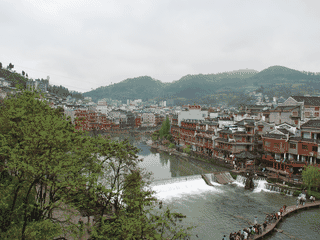
- Three centuries of Ming- and Qing-era buildings line the Tuojiang River.
- Locals still do laundry and children play along the stone steps by the water.
- Ginger candy is made and sold through the old town for ¥2-4 a bag.
See also
Zhangjiajie
China29.12°N 110.48°E
Overview
Fenghuang is a riverside historic town lined with Ming and Qing architecture. Its literary and artistic heritage, plus everyday waterway life along the Tuojiang, gives walks through the old town a lived-in feel.
Languages: Chinese
Why go?
Fenghuang is one of China's best-preserved ancient towns, with 300 years of Ming and Qing dynasty architecture lining the Tuojiang River. The town is the birthplace of celebrated writer Shen Congwen and home to artist Huang Yongyu, giving it a strong literary and artistic heritage. Unlike more commercialized ancient towns, Fenghuang retains authentic waterway life where locals do laundry and children play along stone steps leading to the river.
Adapted from Wikivoyage contributors · CC BY-SA 4.0
Getting in
High-speed trains to Fenghuanggucheng Railway Station (凤凰古城站) are the easiest approach, with 2-2.5 hours from Changsha and 50-65 minutes from Zhangjiajie. The station connects to the town via maglev line and express buses. Before the 2021 railway, most visitors arrived by car or bus from Jishou (30 minutes via expressway). Expect crowded buses and roads on weekends and Chinese holidays.
Adapted from Wikivoyage contributors · CC BY-SA 4.0
Getting around
Fenghuang Old Town is compact and best explored on foot along cobblestone streets and riverside pathways. Taxis connect the bus stations to the main Old Town entrance. The old town is not wheelchair accessible due to uneven stone paths and steps.
Adapted from Wikivoyage contributors · CC BY-SA 4.0
When to go
Spring and autumn offer the most comfortable temperatures for walking the old town streets. Summer brings crowds of domestic tourists and higher prices. The town looks particularly atmospheric during early mornings when mist rises from the river and street vendors are just setting up.
Adapted from Wikivoyage contributors · CC BY-SA 4.0
See
Fenghuang's attractions are sold through "through tickets" (通票). The basic ¥98 ticket covers Yang Family Ancestral Hall, East Gate Tower, and the upper gallery of Hong Bridge. The ¥148 two-day ticket adds Gucheng Museum and Wanshou Temple. The regional ¥168 three-day ticket includes the Southern Great Wall and Miao Village. Individual entry to Wanshou Temple costs ¥50 and Gucheng Museum ¥48. Hong Bridge and Queen of Heaven Temple are free to enter.
Adapted from Wikivoyage contributors · CC BY-SA 4.0
Do
The Southern Great Wall (南方长城) lies 15 km west of town and offers strenuous hiking with panoramic views of rice terraces and countryside. A biennial Ancient City of the Phoenix Cup Go tournament uses live players in traditional clothing as game pieces. Minivan drivers will offer transport but always bargain first; alternatively take bus #2 to the big bus station and transfer to an unnumbered bus for the return leg.
Adapted from Wikivoyage contributors · CC BY-SA 4.0
Buy
Fenghuang is famous for ginger candy (姜糖), with vendors throughout the Old Town making and selling bags for ¥2-4. The local Miao people are renowned for handcrafted silverwork, with several shops in the old town offering quality pieces. Be cautious of cheaper mass-produced trinkets sold at tourist-oriented stalls.
Adapted from Wikivoyage contributors · CC BY-SA 4.0
Eat
Night street food along the old town streets features grilled meats, dumplings, fried potatoes, flat breads, and grilled vegetables at budget prices. Hot pot restaurants specializing in local Hunan cuisine are scattered throughout the old town and along the riverfront.
Adapted from Wikivoyage contributors · CC BY-SA 4.0
Drink
The river-facing streets come alive at night with karaoke bars glowing with neon lights and blasting music until midnight. Local shops sell 330 ml bottles of beer for around ¥3-5, while bar prices run ¥25 or ten times that amount.
Adapted from Wikivoyage contributors · CC BY-SA 4.0
Where to stay
Inns cluster along Bei Bian Jie (北边街) between the Northern Wall and the river, offering atmospheric stays in converted traditional buildings. The Fenghuang Huxiangyi International Youth Hostel at No. 20 Wujia Lane on Dongzheng St provides dorm beds and private rooms. Larger hotels catering to tour groups line the city center and roads approaching both bus stations.
Adapted from Wikivoyage contributors · CC BY-SA 4.0
Go next
Frequent buses connect Fenghuang to Jishou (for Zhangjiajie), Huaihua, Changsha, and Wulingyuan. Direct long-distance buses run to Wuhan (¥200), Guangzhou via Zhuhai and Shenzhen (¥260), Chongqing (¥165), Guilin, Nanning, and Kunming with variable prices and departures.
Adapted from Wikivoyage contributors · CC BY-SA 4.0
Field guide adapted from Wikivoyage contributors · CC BY-SA 4.0. Text has been adapted and organized for this guide. About our sources.
Places to know
A few starting points from the guide. Check current hours and prices before you go.
- sleep
Fenghuang Huxiangyi International Youth Hostel
Adapted from Wikivoyage contributors
- see
East Gate Tower
Recorded price: Included in through ticket
Adapted from Wikivoyage contributors
- see
Former Home of Shen Congwen
Recorded price: Included in through ticket
Adapted from Wikivoyage contributors
- see
Gucheng Museum
Recorded price: ¥48 individually, or included in through ticket
Adapted from Wikivoyage contributors
- see
Hong Bridge
Recorded price: Free; upper gallery included in through ticket
Adapted from Wikivoyage contributors
- see
Queen of Heaven Temple
Recorded price: Free
Adapted from Wikivoyage contributors
- see
Southern Great Wall
Ming dynasty frontier wall section 15km west of town with scenic rice terrace views and hiking trails
Recorded price: ¥168 regional ticket or ¥50 separately
Adapted from Wikivoyage contributors
- see
Wanshou Temple
Recorded price: ¥50 individually, or included in through ticket
Adapted from Wikivoyage contributors
Before you go
Language
Mandarin is the primary language. The surrounding region has a significant Miao minority population. English is limited outside tourist areas.
Money
Prices quoted in Chinese Yuan (¥). Most small vendors and street food stalls are cash-only. WeChat Pay and Alipay are accepted at most shops and restaurants.
Tickets
Three through-ticket options exist: ¥98 (basic, 1 day), ¥148 (with museum, 2 days), or ¥168 (regional, 3 days). Individual attractions cost ¥48-50 extra if bought separately.
Transport
High-speed train is the most convenient option from Changsha and Zhangjiajie. Local buses #2 serves the big bus station. Taxis available from both bus stations to the Old Town entrance.
Weather
Summers are hot and humid; winters can be cold. Spring and autumn offer the most comfortable conditions for exploring the old town streets.