
Bucharest
Eastern Europe and the Balkans · Romania
Did you know?
- The Village Museum displays traditional houses from across Romania.
- LUCA pastry shops sell covrigi alongside coffee.
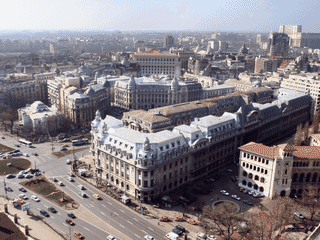
- Old churches stand beside glass towers and communist-era buildings.
See also
Ploiești
Romania44.93°N 26.03°E · 165 m
Overview
Bucharest mixes historic churches, communist-era buildings and modern towers. Its renovated old town gathers restaurants and clubs along cobblestoned streets.
Languages: Romanian
Why go?
Bucharest is Romania's capital and largest city, offering a fascinating mix of old and new: 300-year-old churches next to steel-and-glass towers and communist-era buildings. The old town has been renovated with cobblestoned streets, clubs, and restaurants. It is the primary entry point into Romania and has a vibrant cultural scene.
Adapted from Wikivoyage contributors · CC BY-SA 4.0
When to go?
Bucharest has a temperate-continental climate with hot summers (up to 30°C) and cold winters (as low as -20°C). The best time to visit is April through June, September through October, and early December. Spring is brief and falls mainly in April.
Adapted from Wikivoyage contributors · CC BY-SA 4.0
Getting in
Henri Coandă International Airport (OTP) is 18 km north of the city center, served by express bus 783 and taxis. Gara de Nord is the main railway station with connections across Romania and Europe. Several bus terminals (Filaret, Obor, Băneasa) serve regional and international buses.
Adapted from Wikivoyage contributors · CC BY-SA 4.0
Getting around
Bucharest has an extensive public transport network including four metro lines, trams, buses, and trolleybuses. The city center is walkable. Taxis are available but only use licensed ones (Meridian Taxi at Gara de Nord). Tickets can be purchased at kiosks and validated on board.
Adapted from Wikivoyage contributors · CC BY-SA 4.0
Where to stay
Accommodation ranges from hostels like Butterfly Villa (from €10) and Midland Hostel (from €11) to budget hotels near Gara de Nord and mid-range hotels in the center. The old town and areas near Piata Romana are popular. For a stay near the airport, consider Vienna House Easy or Hilton Garden Inn.
Adapted from Wikivoyage contributors · CC BY-SA 4.0
Food and drink
Traditional Romanian cuisine includes dishes like mici, sarmale, and ciorbă. Caru' cu Bere is a famous restaurant in a historic building with a student menu for 14.50 lei. For cheap eats, the pastry chain LUCA offers covrigi and coffee. The old town is packed with pubs and clubs, from rock bars like Fire Club to upscale clubs like Bamboo.
Adapted from Wikivoyage contributors · CC BY-SA 4.0
Things to do
Key attractions include the Palace of the Parliament (the world's second-largest building), the Romanian Atheneum, the Village Museum, and several parks like Cișmigiu and Herăstrău. The thermal water park Therme București is a popular day trip. For nightlife, the old town has many bars and clubs.
Adapted from Wikivoyage contributors · CC BY-SA 4.0
Safety
Bucharest is one of the safest capitals in Europe, but violence is not uncommon, especially in clubs late at night. Avoid conflict. The emergency number is 112. Crime rate is low but be cautious. Violent attacks are rare.
Adapted from Wikivoyage contributors · CC BY-SA 4.0
Connectivity
As of November 2021, 5G coverage is available with Orange and Vodafone, and some areas with Digi and Telekom. Wi-Fi is widely available in public places. SIM cards can be bought at the airport from a newspaper stand.
Adapted from Wikivoyage contributors · CC BY-SA 4.0
Day trips
Nearby destinations include Brasov (160 km north), Constanța on the Black Sea, and the ski resorts Sinaia, Poiana Brașov, and Predeal. The scenic Transfăgărășan road is also accessible. International trips to Budapest, Istanbul, and Sofia are possible but longer.
Adapted from Wikivoyage contributors · CC BY-SA 4.0
Go next
From Bucharest, travel to Transylvania for medieval towns like Brașov, Sibiu, and Sighișoara. The Black Sea coast at Constanța is 225 km east. Ski resorts include Sinaia and Predeal. For international travel, Budapest, Istanbul, and Sofia are within a day's journey.
Adapted from Wikivoyage contributors · CC BY-SA 4.0
Field guide adapted from Wikivoyage contributors · CC BY-SA 4.0. Text has been adapted and organized for this guide. About our sources.
Places to know
A few starting points from the guide. Check current hours and prices before you go.
- drink
1974 Niște Domni și Fiii
Adapted from Wikivoyage contributors
- buy
AFI Palace Cotroceni
Adapted from Wikivoyage contributors
- drink
Absintherie Sixtină
Classic style bar with reasonable prices. The absinthe is served with a slow drip fountain.
Adapted from Wikivoyage contributors
- buy
Anthony Frost English Bookshop
An English-language bookstore. Lots of reasonably-priced books and a comics (mostly manga) section.
Adapted from Wikivoyage contributors
- drink
BEAT bar umanist
Nice cosy bar near Unirii/old town.
Adapted from Wikivoyage contributors
- do
Botanical Gardens
Established in 1860, displays a variety of plants from all over the world. The greenhouses are wonderful but have limited opening hours, and are closed Monday, Wednesday and Friday
Recorded price: 10 Lei
Adapted from Wikivoyage contributors
- buy
Bucharest Mall
The first one to be completed, in 1999.
Adapted from Wikivoyage contributors
- buy
Băneasa Shopping City
Opened in April 2008.
Adapted from Wikivoyage contributors
Before you go
Connectivity
Wide 5G coverage, Wi-Fi in public places. SIM cards available at airport.
Culture
Romanian is the official language; younger people speak English. French and Italian are also understood by older generations.
Emergency
Emergency number: 112.
Health
Tap water is potable. Summer heat can be intense; carry water. Pharmacies open 09:00-18:00, some 24h.
Language
Official language Romanian. Young people speak English well; older generation may speak French.
Local transport
Metro runs 5:00–23:00. Single tickets 3 lei. STB card can be purchased at metro stations. Trams and buses cover the rest.
Money
Romanian Leu (RON) is the currency. Credit cards widely accepted, ATMs available. Exchange offices offer poor rates at airports and train stations.
Safety
Bucharest is safe, but avoid conflicts in clubs. Emergency number: 112.
Transport
Efficient public transport: metro, trams, buses. City center walkable.
Visa context
Visa rules depend on passport; check current entry requirements before traveling.