Overview
Abu Simbel is a small Nile-side base built around two monumental temples rescued from the rising waters of Lake Nasser. The temples reward an early visit, while an overnight stay adds quieter access and a chance to see the reconstructed engineering inside the dome.
Architecture · History · Lake · Day Trips
Did you know?
- Sunlight reaches the sanctuary around the annual February and October alignment.
- Look for the tiny “Kilroy was here” graffiti on a statue's lower legs.
- The relocated temples were cut into numbered stone cubes and reassembled uphill.
Overview
Small enough to navigate on foot.
Understand
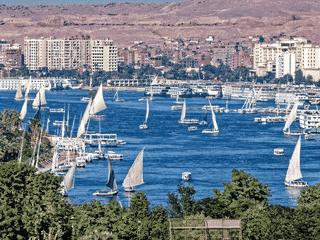
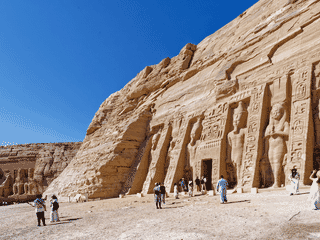
Abu Simbel is a small village 280 km south of Aswan and 40 km north of the Sudanese border. The village has little else to offer visitors beyond its famous temples. The Great Temple and Nefertari’s Temple were originally carved into a hillside facing the Nile, but rising waters from Lake Nasser (behind the Aswan Dam) threatened them. In the 1960s, UNESCO coordinated a massive archaeological rescue: each temple was sawn into numbered stone cubes, moved uphill, and reassembled before the water rose. The Great Temple now sits inside a dome-shaped fake mountain, with the stone cubes occupying a section beneath the dome—a remarkable feat of engineering visible from inside.
Getting there
Most visitors arrive from Aswan via EgyptAir flights (up to four daily), with EgyptAir operating from Abu Simbel Airport. Flights from Aswan are the fastest option at approximately 40 minutes. Bus and taxi options are also available for the overland route from Aswan.
Climate
Summers are extremely hot, while winters are warm during the day and mild at night. Rainfall is almost nonexistent. The best time to visit is from November through February. Abu Simbel feels at least 10°C (20°F) colder than Aswan due to Lake Nasser and winds coming off it. Bring warm clothing and a scarf, especially in winter when temperatures drop to around 5–10°C with strong wind.
Get around
The village of Abu Simbel is small enough to navigate on foot. The temples are within walking distance from the main settlement area.
Where to stay
Most visitors come as day trips from Aswan, but five hotels cater to those staying overnight. Accommodation prices are higher than equivalent hotels in Cairo due to the isolated location. Options include Seti Abu Simbel (5-star chalets overlooking Lake Nasser), Eskaleh Nubian Ecolodge (traditional mud-brick building), Nefartari Hotel (resort with pool and gardens), Nobaleh Ramsis Hotel, and Abu Simbel Tourist Village/Hotel Abbas for budget travelers. Staying overnight lets you attend the Sound & Light show or visit the temples when day-trippers have departed.
Things to do
The Great Temple of Ramses II is the main attraction: carved between 1274–1244 BC, featuring four statues each over 20 m high. Twice yearly (February 22 and October 22), sunlight penetrates the sanctuary to illuminate the statues of Ramses II, Amun-Ra, and Ra-Horakhty—though not Ptah (god of the underworld). Due to the temple’s relocation, the sunlight event now occurs one day later. Look for the “Kilroy was here” graffiti on the lower legs of one statue. Guards check for photo permits (tripod permit LE20 extra). Nefertari’s Temple of Hathor, the smaller companion temple, is included with your ticket. Early morning boat tours of Lake Nasser and sunrise viewing can be arranged through Eskaleh Nubian Lodge.
Food and drink
Bring your own snacks and beverages due to the length of the journey and limited time at Abu Simbel. Several cafes line the main road, though prices are high due to the tourist traffic. Tuya Restaurant (on Ramsis Rd, around 700 m from temple entry) offers a nice cafe with garden and sheesha at LE200–LE400. Wadi el-Nil and Nubian Oasis are also along the main road, though their listings show no current contact details or prices, and some cafes listed may no longer exist as of 2026.
Go next
Abu Simbel lies in Upper Egypt, 280 km from Aswan via air or road. Aswan is the primary onward hub for Nile cruises, Philae Temple, and the High Dam. Further south lies the Sudanese border, requiring appropriate border crossing arrangements. The nearest major airport is Abu Simbel Airport with EgyptAir connections to Aswan.
Guide text adapted from Wikivoyage contributors under CC BY-SA 4.0.
Where to start
Sleep
Abu Simbel Tourist Village/Hotel Abbas
Price when recorded: about LE100
Sleep
Eskaleh Nubian Ecolodge
Traditional mud-brick building with standard and superior rooms. Food available until 9PM.
Price when recorded: LE500-700
Sleep
Nefartari Hotel
Less than a 10-min walk from the temple site. A resort spread around lovely gardens with a pool overlooking Lake Nasser. The rooms are clean, but very dated. Very ordinary complete dinner for LE150.
Price when recorded: Single US$80, double US$100, suite US$150, breakfast included
Sleep
Nobaleh Ramsis Hotel
Price when recorded: about LE200
Sleep
Seti Abu Simbel
5-star hotel a 20-min walk from the temples along a busy road. Chalet-style rooms overlooking Lake Nasser. Meals available.
Price when recorded: Single US$130; Double US$180
Eat
Nubian Oasis
Eat
Tuya Restaurant
Nice cafe with lovely garden. Stop for a sheesha if you have time.
Price when recorded: LE200 - LE400
Eat
Wadi el-Nil
Before you go
Accommodation
Five hotels serve overnight visitors. Budget options start around LE100–LE200, while 5-star hotels charge US$80–$180. Prices are inflated compared to equivalent Cairo hotels.
Money
Prices are significantly higher than Cairo due to the remote location. Cash (Egyptian Pounds) is recommended for small purchases; credit cards may work at hotels but not at local cafes.
Transport
EgyptAir flies up to four times daily between Aswan and Abu Simbel Airport. Buses and taxis are alternative overland options. The village is walkable once you arrive.
Visiting
The temples are open 6AM–5PM daily. Photo permits are required inside the main temple; tripods cost extra. Go inside the dome of the Great Temple to see how the reconstructed mountain was built.
Weather
Visit November–February for comfortable temperatures (15–30°C range). Expect 10°C cooler conditions than Aswan due to Lake Nasser winds. Bring layers even in summer.