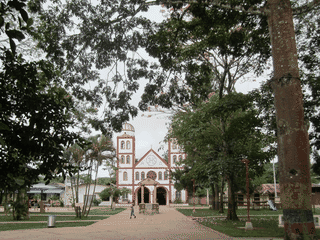

La Macarena
South America · Colombia
Did you know?
- Macarenia clavígera gives the river its seasonal red color.
- Caño de Piedras is a swimming and picnic spot that draws local crowds on Wednesdays.
- La Casa del Pan and Pan Unicrema serve arepas alongside baked goods.
See also
Neiva
Colombia3.00°N 75.30°W · 442 m
Overview
La Macarena is a base for Caño Cristales. Rock pools, rapids and waterfalls take on seasonal color from red and green plants.
Languages: Spanish
Why go?
La Macarena is a tiny pueblo in Meta's southern plains, famous as the gateway to Caño Cristales—often called the Most Beautiful River in the World. From July through October, the river blazes with ruby-red plants (Macarenia clavígera), earning it nicknames like the Liquid Rainbow and River of Seven Colors. The town itself is a sleepy, remote outpost with basic amenities, but it's the surrounding Serranía de la Macarena that draws travelers seeking dramatic landscapes, natural swimming pools, and off-the-beaten-path adventure.
Adapted from Wikivoyage contributors · CC BY-SA 4.0
Getting in
Satena Airlines is the only regular commercial operator, flying from Bogotá on Sundays, Wednesdays, and Fridays (three flights per week), plus some flights from Medellín. Alternatively, take a bus from Bogotá to Villavicencio and catch a charter flight to La Macarena—private charters are pricier but more flexible. A few Bogotá hostels like Hostal Martinik in La Candelaria can arrange complete packages with private flights. The town has no road access; the Guayabero River is the only route elsewhere.
Adapted from Wikivoyage contributors · CC BY-SA 4.0
Getting around
La Macarena is tiny—you can walk from the airport to any local hotel in under five minutes. The town uses an orderly numbered grid, but you won't need to memorize it. To reach Caño Cristales and Serranía de la Macarena, a guide is mandatory (both for environmental protection and your safety). Your guide arranges river crossings by boat, then transport by jeep, bicycle, motorcycle, or even horse to the river. The 'port' is down a little road at the far side of the park.
Adapted from Wikivoyage contributors · CC BY-SA 4.0
When to go
Temperatures stay warm year-round: lows of 21–23°C and highs of 26–32°C. The famous red 'blossoms' of Macarenia clavígera appear only July through October (possibly into November). For the most spectacular color display, pair the flowering season with sunny weather, most likely from September to February. The wet season brings more runoff that can muddy the water's clarity.
Adapted from Wikivoyage contributors · CC BY-SA 4.0
Where to stay
Hotels cluster around the central park and on Calle 5 (where Hotel la Cascada's sign is prominent). There's no need to book ahead—spare capacity is almost guaranteed, and you can inspect rooms before committing. All lodgings offer private-bath-plus-TV (sometimes A/C) rooms or shared-bath no-TV options. Note that power sometimes cuts out in the evenings, rendering TV and A/C useless. Showers are always cold. Camping is prohibited inside the National Park, so you'll stay in town and commute daily.
Adapted from Wikivoyage contributors · CC BY-SA 4.0
Food and drink
Plenty of cheap restaurants and panaderías line the streets. La Casa del Pan (Calle 5, 7-66) and Pan Unicrema (Carrera 7, 7-08) serve arepas and baked goods from COP$500. For sit-down meals, Restaurante Brisas del Guayabero (COP$6,000–8,000) offers hearty soups and good value, while Punto Verde on the park (COP$7,000–10,000) serves large portions with more meat than elsewhere. El Café de Lithos (behind the police station, Tu-Su 4–10:30PM) is the go-to for vegetarian/vegan travelers, with causa peruana, waffles, and signature gyarapo frappe. After dark, food stalls near the football field sell Mona's empanadas at just 500 COP each. Note: local cheese is the skunky variety that many foreigners dislike.
Adapted from Wikivoyage contributors · CC BY-SA 4.0
Things to do
Caño Cristales is the main attraction: a spectacular river where rock formations, natural pools, rapids, and waterfalls are enhanced by red and green plants depending on season. Guides officially count five colors (black, green, white, yellow, ruby red), but curious travelers often spot six or seven. The walk through the river is the highlight. Nearby, Caño de Piedras has a popular natural pool where locals gather on Wednesdays—a budget-friendly alternative if you're skipping Caño Cristales. El Raudal features rapids and ancient petrogllyphs visible in summer, administered by the local community. Finca Cristalitos (a Caño Cristales affluent) offers camping and farm-fresh food with mountain views. Evening Llanero music/dance shows at 7pm (around 20,000 COP with optional dinner) run at Hotel San Nicolas or El Caporal.
Adapted from Wikivoyage contributors · CC BY-SA 4.0
Safety
Despite being surrounded by genuinely dangerous regions, the military maintains firm control of La Macarena and conducts regular patrols. Real risks include slipping on rocks, sunburn, and heat exhaustion—bring at least two liters of water daily. Malaria risk is low but serious: doxycycline (doxiciclina) is inexpensive in Bogotá and Villavicencio—visit any droguería and ask for 30 tablets plus the number of days you'll spend in La Macarena, at 100 mg dosage. Power cuts are common in the evening.
Adapted from Wikivoyage contributors · CC BY-SA 4.0
Connectivity
Free but slow Wi-Fi is available in the public park. Only a few hotels offer connectivity; Café de Lithos provides free internet for patrons. Two internet cafes operate afternoons only (power cuts occur around dinner): Calle 5, 7-70 is faster but malware-infested, while Calle 8, 7-76 near the airport is slower but run by the friendliest people in town. Both charge COP$2,500/hour. Most mobile network providers have decent coverage in town, with shops selling minutes and data.
Adapted from Wikivoyage contributors · CC BY-SA 4.0
Budget
La Macarena is relatively cheap for a remote destination. Budget accommodations range from COP$10,000–40,000/night; mid-range hotels run COP$25,000–80,000. Meals at panaderías cost 500–2,500 COP; restaurant dinners are 6,000–12,000 COP. Internet cafes charge 2,500 COP/hour. The main expense is the guided tour to Caño Cristales (typically bundled with transport, meals, and guide). Evening entertainment is cheap—pool halls serve Aguila and Poker on every corner.
Adapted from Wikivoyage contributors · CC BY-SA 4.0
Day trips
Caño Cristales is the primary day trip, requiring a full day with a guide. Caño de Piedras is a shorter moto-taxi ride for swimming and picnics (locals pack it on Wednesdays). The Jardín Botánico in nearby La Esperanza (18 km) focuses on native plant and animal conservation. For adventurous travelers, Finca Cristalitos offers camping and views over the region. The Guayabero River's rapids at El Raudal include visible ancient petrogllyphs in summer.
Adapted from Wikivoyage contributors · CC BY-SA 4.0
Go next
Sierra de la Macarena National Natural Park and Tinigua National Natural Park are adjacent protected areas worth exploring. For more wildlife viewing in the Serranía de la Macarena, consider approaching from the north via San Martín (but confirm with a Villavicencio tour agency first). If Caño Cristales is too far off your route, alternative colorful rivers exist in Guaviare department, Santander, and on the Colombia-Venezuela border—including Tranquilandia in Guaviare, Quebrada Las Gachas, and the Atabapo River.
Adapted from Wikivoyage contributors · CC BY-SA 4.0
Buy
Tourist shops occupy about a third of real estate on main streets. The most practical purchase is a hat with neck cover to prevent sunburn. Find them at Miscelanea Traslevina, Variedades Rey, and Wilyani—all next to each other on Calle 5, opposite Hotel La Cascada. Typical tourist handicrafts and souvenirs are available, but selection is limited.
Adapted from Wikivoyage contributors · CC BY-SA 4.0
Etiquette
As a small Colombian pueblo, La Macarena appreciates respectful behavior. Dress modestly when visiting the church or town center. Ask permission before photographing locals. Tipping is appreciated but not obligatory for casual service. Bargaining is appropriate at markets but not in restaurants or hotels.
Adapted from Wikivoyage contributors · CC BY-SA 4.0
See
There's not much to see in town itself—the main attraction is Caño Cristales. The one park is a pleasant shaded spot by the church. Military planes occasionally sit at the airport. When booking a Caño Cristales guide, you'll receive a brief orientation tour of the pueblo pointing out favorite restaurants and hotels.
Adapted from Wikivoyage contributors · CC BY-SA 4.0
Drink
Pool halls dominate the nightlife, with the largest ones on the main road near Calles 6 and 7. Aguila and Poker are the standard beers, sold at open-air spots on nearly every corner. Tables are usually available after a couple of beers. The atmosphere is casual and social—ideal for meeting other travelers between daily excursions.
Adapted from Wikivoyage contributors · CC BY-SA 4.0
Field guide adapted from Wikivoyage contributors · CC BY-SA 4.0. Text has been adapted and organized for this guide. About our sources.
Places to know
A few starting points from the guide. Check current hours and prices before you go.
- sleep
Casa Hotel Real
A nice sunny, breezy option with friendly staff. Sort of in the mid-range of things here. Optional A/C.
Recorded price: COP$25,000/35,000
Adapted from Wikivoyage contributors
- sleep
Hospedaje los Cristales
A bottom budget option. It's a little loud at night, no A/C—just fans, and the rooms aren't as nice as those at some other hotels, but the family that runs the outfit is nice, and the price is certainly right.
Recorded price: COP$10,000/20,000
Adapted from Wikivoyage contributors
- sleep
Hotel Macarena
A basic low budget hotel with clean rooms and friendly staff. 25000 COP/20000 COP for rooms with/without a private bathroom.
Recorded price: COP$20,000/25,000
Adapted from Wikivoyage contributors
- sleep
Hotel San Nicolas
A family-run property with standard private rooms or dormitories. All rooms are spacious and airy, have their own bathroom with a shower and toilet, and are equipped with a TV set.
Recorded price: COP$40,000
Adapted from Wikivoyage contributors
- sleep
Hotel la Cascada
Despite the very unassuming exterior, this is probably the nicest hotel in town, with an immaculately clean and somewhat cavernous interior, comfy beds, and lots of A/C. The prices are a bit on the high side for the better rooms, though.
Recorded price: COP$80,000/120,000
Adapted from Wikivoyage contributors
- eat
El Café de Lithos
It is a very special place where loud music is forbidden and all people is welcome. Locals use to interact with tourists (same low prices for everyone) and share food that you can't find in any other place in town: causa peruana, waffles, desserts, vegan and vegetarian food. Also, a variety of coffees, teas and infusions. You should try gyarapo frappe and citric lemonade, two of their signatures beverages.
Adapted from Wikivoyage contributors
- eat
La Casa del Pan
There are plenty of panaderías in town, but this is one of the friendliest, and pretty conveniently located. And they won't randomly try to gouge you on soda prices.
Recorded price: COP$500-2,500
Adapted from Wikivoyage contributors
- eat
Mona's Empanadas
As dusk sets in, temporary food stalls sprout out in the area next to the football ground. One of the more popular stands is Mona's - freshly rolled and fried hot empanadas for just 500COP a piece. Be prepared to patiently wait if it's crowded, which always seems to be the case. Try the piña salsa and the salsa blanca (tartare).
Recorded price: COP$500/empañada
Adapted from Wikivoyage contributors
Before you go
Accommodation
Hotels cluster around the park and Calle 5. No booking needed—spare capacity is common. Power cuts in evenings affect A/C and TV.
Connectivity
Slow WiFi in central park. Two internet cafes (afternoon only) charge 2,500 COP/hour. Mobile coverage is decent with major providers.
Food
Local cheese is the strong, skunky variety that foreigners often dislike. Panaderías serve cheap food from 500 COP. Mona's empanadas near the football field are popular after dark.
Health
Malaria risk is low but real. Doxycycline available cheaply in Bogotá and Villavicencio. Cold showers only at all hotels.
Money
Local currency is Colombian Peso (COP). ATMs are limited in this remote town—bring sufficient cash from larger cities. Internet cafes charge 2,500 COP/hour.
Safety
Military presence is strong; town is safe for tourists. Malaria prophylaxis recommended. Bring 2L water daily to avoid heat exhaustion.
Transport
Satena Airlines flies from Bogotá (Sun, Wed, Fri) and Medellín. No road access exists; the Guayabero River is the only other route. Within town, everything is walkable.
Visa
Standard Colombian entry requirements apply. Check current visa rules before traveling to Colombia.
Weather
Year-round temperatures of 21–32°C. Best time for Caño Cristales's red blooms is July–October. Sunny weather most likely September–February.