
Datong
East Asia · China
Did you know?
- The ancient city is walkable, while local buses cost ¥1 per ride.
- The Northern Wei capital Pingcheng later served as a secondary capital under the Liao and Jin.
- Yungang Grottoes contain 51,000 Buddhist statues.
See also
Overview
Datong combines low prices and many attractions with fewer tourists than Beijing and Xi'an. It suits travelers looking for a quieter, culture-focused base in North China.
Languages: Chinese
Why go?
Datong offers convenient transportation, relatively low prices, a good environment, and numerous tourist attractions, making it one of the most worthwhile tourist destinations in North China. Compared to major cities like Beijing and Xi'an, there are fewer tourists, making it more suitable for in-depth cultural experiences.
Adapted from Wikivoyage contributors · CC BY-SA 4.0
Understand
Datong is a small city with relatively little experience with foreigners. People here are friendly and curious. Datong served as the capital (Pingcheng) during the Northern Wei Dynasty, and as a secondary capital during the Liao and Jin Dynasties.
Adapted from Wikivoyage contributors · CC BY-SA 4.0
Climate
Temperate continental semi-arid monsoon climate with distinct four seasons. It is dry, cold and windy, with large temperature differences. Recommended to keep long sleeves to keep out the cold.
Adapted from Wikivoyage contributors · CC BY-SA 4.0
Get around
Local buses (¥1 per ride) and taxis (¥8 starting fare) are available. Bus #3, 12, 37 go to Yungang Grottoes. The ancient city is walkable.
Adapted from Wikivoyage contributors · CC BY-SA 4.0
Things to do
Top attractions include the UNESCO-listed Yungang Grottoes (¥100, 51,000 Buddhist statues), the Hanging Monastery (¥115, built 490), Yingxian Wooden Pagoda (¥60, oldest wooden pagoda), Huayan Monastery (¥50, Liao-Jin dynasty temple), Nine Dragon Screen (¥10, oldest glazed screen), and the free city walls. Many sites offer student/half-price discounts.
Adapted from Wikivoyage contributors · CC BY-SA 4.0
Where to stay
Budget options include the Qingnian Lüsü Youth Hostel (dorm ¥50, private ¥158) near Huayan Monastery, and Tongming Kuàijié Jiǔdiàn (double from ¥100) near the train station. The Hongqi Grand Hotel offers comfortable rooms from ¥265.
Adapted from Wikivoyage contributors · CC BY-SA 4.0
Food and drink
Local specialties include chuanr (meat skewers) near Red Flag Square. Madaha Hotpot (per-person pot, free sides) is popular. Best Pizza serves passable Western food from ¥50. Yùshèngxiáng Tea house offers tea from ¥10 and a relaxing atmosphere.
Adapted from Wikivoyage contributors · CC BY-SA 4.0
Go next
Buses to Beijing (¥128, 4½ hr), Wutai Shan (¥75, 4 hr), Taiyuan (frequent). Book tickets early at train station. Xīnnán Bus Station is accessible by bus #30 from the train station.
Adapted from Wikivoyage contributors · CC BY-SA 4.0
Field guide adapted from Wikivoyage contributors · CC BY-SA 4.0. Text has been adapted and organized for this guide. About our sources.
Places to know
A few starting points from the guide. Check current hours and prices before you go.
- sleep
DaTong Green Island Youth Hostel Railway Station
A young hostel offering most satisfying help by the staff.
Recorded price: ¥160 for double room
Adapted from Wikivoyage contributors
- sleep
Datong Binguan
Adapted from Wikivoyage contributors
- sleep
Hongqi Dafandian
Adapted from Wikivoyage contributors
- eat
Best Pizza
Consider for the experience, not the food. Chinese-style western restaurant, designed for Chinese people, not Westerners (i.e. luxurious sofas as seats, ice in champagne bucket to put in your beer to make it cold, asking for salt&pepper not thought strange but not already at every table, only has squat toilet). You will probably think the thick-base pizza is a reasonable imitation, but you may also realise why some Chinese people say that Western food basically isn’t as tasty as Chinese food. ¥50 up. Other passable Western food.
Adapted from Wikivoyage contributors
- eat
Mǎdàhā Hotpot
A well-known place among locals serving Shanxi hotpot although the same is now available everywhere in other China where each person has their own pot instead of sharing. There are several locations for this chain in Datong alone. You pick your soup and meats, then take a tray for the veggie and seafood. Drinks, ice cream, sauce, cold side dishes and fruit are free. Some locations have a play ground for kids inside. Very family friendly place.
Adapted from Wikivoyage contributors
- see
Ancient Bronze Art Museum
This is part of the Datong Museum. Datong is renowned for its bronze ware production, with a documented history of over 600 years, and it is now a "National Intangible Cultural Heritage Representative Project." The museum's permanent exhibition, "Bronze Splendor in Datong: Ming and Qing Dynasty Datong Bronze Art Exhibition," includes imitations of Shang and Zhou bronze ritual vessels, Xuande incense burners, scholar's objects, and Mongolian and Han goods made in the Datong area during the Ming and Qing dynasties. It is divided into four sections: "Ancient Charm and New Style," "Masterful Craftsmanship," "Leisurely Appreciation," and "Luxurious Bronze Enjoyment," showcasing the bronze-making techniques of the Datong area during the Ming and Qing dynasties and offering a glimpse into the commercial, cultural, and ethnic integration of Datong during that period.
Recorded price: Free
Adapted from Wikivoyage contributors
- see
Chunyang Palace
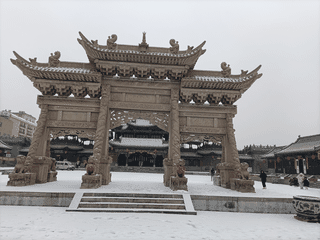
Chunyang Palace is the largest Taoist temple in the ancient city of Datong. The temple is divided into two sections: the western section is a garden, and the eastern section has three courtyards. Along the central axis are the mountain gate archway, Lingguan Hall, Zushi Hall, and Sanqing Hall, with side halls and kiln houses on either side. The palace buildings feature Taoist-themed murals painted by students and faculty of the Mural Painting Department of the China Academy of Art, along with folk mural artisans. The murals are meticulously painted with vibrant colors and gilded details, creating a magnificent spectacle. The palace is a popular place of worship, holding grand religious ceremonies on occasions such as Chinese New Year and Chunyang's birthday. It also offers rituals such as fasting, divination, and character analysis to believers. The "Chunyang Palace Square" is located south of the mountain gate and includes a stone archway, Changsheng Pavilion, Xuantian Pavilion, east and west corridors, east and west Yuxiantai (meeting immortals' platforms), east and west Bagua (eight trigrams) buildings, and Juxianlou (gathering immortals' pavilion). The first floor of Juxianlou is a stage ("Chunyang Palace Stage"), where local traditional dramas such as Jinju, Beilu Bangzi, and Shuahair are performed during traditional festivals.
Recorded price: Free
Adapted from Wikivoyage contributors
- see
Chunyang Taoist Temple
A small collection of Daoist temples and a peaceful courtyard. A more human scale than the nearby Huáyán Monastery - half an hour at most - unless you are intercepted by a Daoist monk and have a chat or are given an explanation. Completely rebuilt in 2010.
Recorded price: ¥30 full price. ¥15 students, etc.
Adapted from Wikivoyage contributors
Before you go
Money
Pay in cash; prices in ¥. Many attractions offer half-price for students and seniors.
Transport
Local bus #3,12,37 to Yungang Grottoes; bus #30 to Xīnán Bus Station. Taxi starter ¥8.